
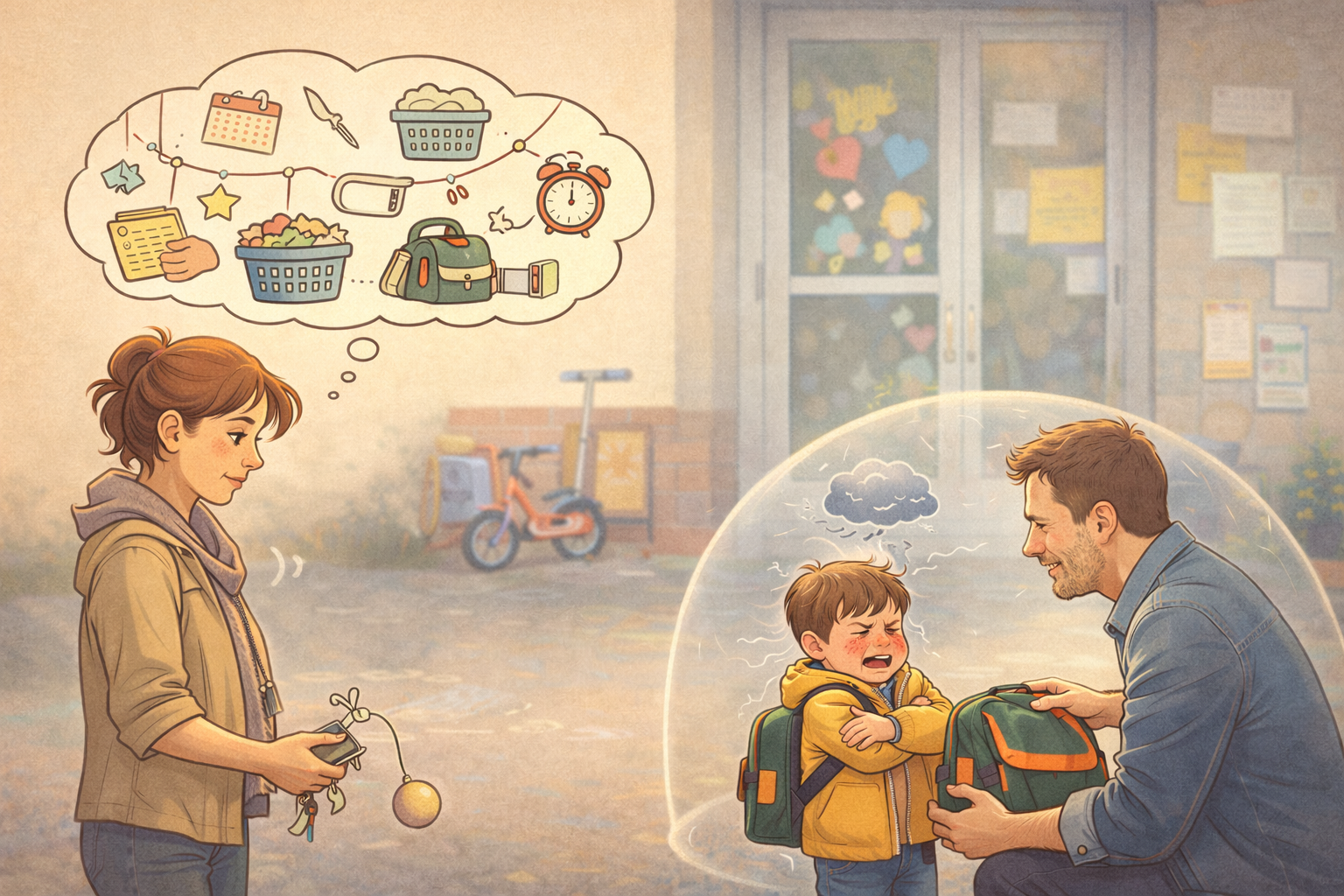
I recently talked to a mother who said something that many know but few say out loud: She often feels guilty because her husband is so much more patient with the children – even though he works too. And her? She loses her temper more quickly.
If you know this, then let me tell you something right at the beginning that you might urgently need to hear: This bad conscience is very often not a sign that you are “not enough”. It is the echo of a system that has long made care work invisible. It is the result of a distribution of burdens that creeps into everyday life – until at some point you believe you just have to manage more, stay calmer, function better.
But the core is different. It is not about who is the better parent. It is about fairness. About responsibility. And about what you, as a mother, may rightfully expect from fathers – especially in the phase when children are about three to five years old and everyday family life becomes demanding in a new way.
⸻
Part 1: Fairness instead of virtue comparison
When a father has more patience, it first sounds like a compliment. And sometimes it is. It becomes problematic when a secret comparison arises from it: Who is the better mother? Who does it more correctly? Who stays calmer?
Because patience is not just character. Patience is also a resource. And resources are distributed unequally – depending on who has been running in high-load mode for how long.
Many mothers carry a stretch that is underestimated from the outside because it seems so “normal”: pregnancy, birth, postpartum period, perhaps breastfeeding, the infant phase, nights that were never truly restful. In addition, there is often something that quietly establishes itself as a role: the default responsible one. The one who thinks of everything. Who senses when the shoes are too small. Who knows that tomorrow is fruit day. Who notices earlier when a tantrum is brewing. Who organizes before something goes wrong.
And then, when children are about three, four, five, it does not suddenly become easy. It becomes different. Less baby survival, more friction. More boundaries, more negotiation. More “I want this now!” and “No!”. More social learning moments in which children practice what they cannot yet do: wait, share, lose, apologize, hold themselves back.
Exactly here, patience is not “nice”. It is sustaining. And it is work.
This is sometimes called co-regulation. That sounds technical. It means something very simple: An adult lends the child their nervous system. You stay calm so the child can become calm. You hold the frame so the child can sort themselves within it. You are not just “not loud”, you are inwardly stable enough to carry the chaos for a moment.
If you currently have less strength for this, it is not a moral problem. It is a structural one. And structural problems are not solved with feelings of guilt, but with a different distribution of responsibility.
In this phase of life, it is not only legitimate but fair to say: If one person has more buffer, then they give more buffer. Not out of generosity. But because that is exactly how family works: resources go where they are needed.
⸻
Part 2: Visibility is not responsibility
Sometimes the observation then comes: “Maybe men only see this when they are at home more.” For example in the home office. That can be true – and it explains a lot without condemning anyone.
Those who are more present in everyday life experience more of the small things that do not feel like “tasks” but drain energy. Not the big highlights. But the ten minutes before leaving the house. The fight about getting dressed. The “No!” when brushing teeth. The screaming because the banana was peeled wrong. The constant interruptions. The constant mental load.
Visibility can be an eye-opener: Oh, I see. This is not “a little on the side”. This is a constant stream. And it is not only physical, it is mental.
But here lies a point that often quietly pulls families apart: Presence is not responsibility.
If a father is “there” but inwardly remains in the role in which he occasionally helps, then little changes. Then the mother continues to carry the leadership, the planning, the thinking ahead. And the father steps in when he is asked – or when he notices. That is nice. But it is not equal.
It only becomes equal when responsibility is taken on as a structure. When someone not only relieves for a moment but carries entire areas. When one does not “help” but is responsible.
This does not mean that everything has to be exactly 50/50, every day, every minute. It means something more practical: reliability. You know that certain things are not hanging on you because the other person is really holding them – from beginning to end.
And this is exactly where you may be clear. Not harsh. Clear. You may say: I do not need more presence. I need ownership. Not “Tell me what to do”, but “I see, I decide, I carry”.
⸻
Part 3: Why care has been invisible for so long – and why this still has an effect today
Part of the problem is older than your relationship. Older than your children. It is embedded in what many of us have unconsciously learned: What counts is what is visible. What is paid. What can be shown.
Care work often has none of that. It produces no tangible completion. It is never “finished”. It consists of many small actions that seem banal individually and together form the foundation of a house.
And it has this bitter characteristic: When it is done well, you hardly notice it. Then things run smoothly. Then nothing escalates. Then there is no crisis that one heroically solves. Good care is often prevention. And prevention is rarely celebrated.
In the generations before us – especially in the post-war and reconstruction decades – value was strongly tied to gainful employment. There were reasons for this: security, rebuilding, clear roles, clear responsibilities. The man outside, the woman inside. Not as malicious intent, but as a social pattern.
However, this pattern has left something that still has an effect today: Care was expected as a matter of course, not recognized as an achievement. The language for it was missing. For mental load, for emotional work, for this constant thinking and empathizing. What has no name is more easily overlooked. And what is overlooked is more easily devalued – not necessarily in the heart, but in priority.
Today, many families live differently. Both work. Both want to be present. And yet, in stressful moments, the old ranking often still applies: gainful employment is considered untouchable, care as “somehow on the side”.
And then something happens that hits mothers particularly hard: A structural problem feels like personal failure. You are not “too sensitive”. You are not “too impatient”. You are in a system that has made care invisible for too long – and you are trying to function within it.
The truth is: Care is not worth less because it is often unpaid. It is often unpaid because historically it was pushed into the private sphere – and because our value scale was miscalibrated for a long time. Once you really see this, something falls away from you. Not everything. But something decisive: the shame.
⸻
What you may expect from fathers
You may expect a father not to see patience as a talent but as a contribution that he actively brings in.
You may expect him not to organize responsibility as “help” but as accountability: entire blocks, entire areas, reliably.
You may expect him not to see the phase in which children become socially “wild” as your problem, but as a joint task – including co-regulation, that calm framework that children are only just learning.
You may expect him not to wait until you ask for relief, but to think along, plan ahead, carry.
You may expect care work to be named as an achievement – not to get applause, but so that it is protected and fairly distributed in everyday life.
You may expect him to acknowledge: Your lower patience is not a character flaw but often a signal of overload – and that he responds to it with responsibility, not with advice.
⸻
Conclusion: Not “doing more”. Distributing better.
Perhaps the most important question is not: “Why am I not more patient?” Perhaps the more important question is: Who is actually carrying the buffer here – and why?
You do not have to make yourself small to keep the peace. You do not have to be ashamed because you are tired. You may be clear. And you may expect that the father of your children is not just there, but truly carries.
Because in the end it is not about who shines. It is about children experiencing adults who do not fight against each other but regulate together. And about mothers not drowning in guilt when the real problem would be a fair distribution.
You are allowed to demand this. Calmly. Warmly. Firmly. Not as an attack. But as what it is: a right to fairness.