
The (from an AI perspective most likely) worldview behind the error-friendly kids’ birthday choreography of a Gen‑Z dance teacher.
Imagine a scene that at first seems small – a children’s birthday party, a group room, music on, a few uncertain steps – and then suddenly becomes big because it says something about our society.
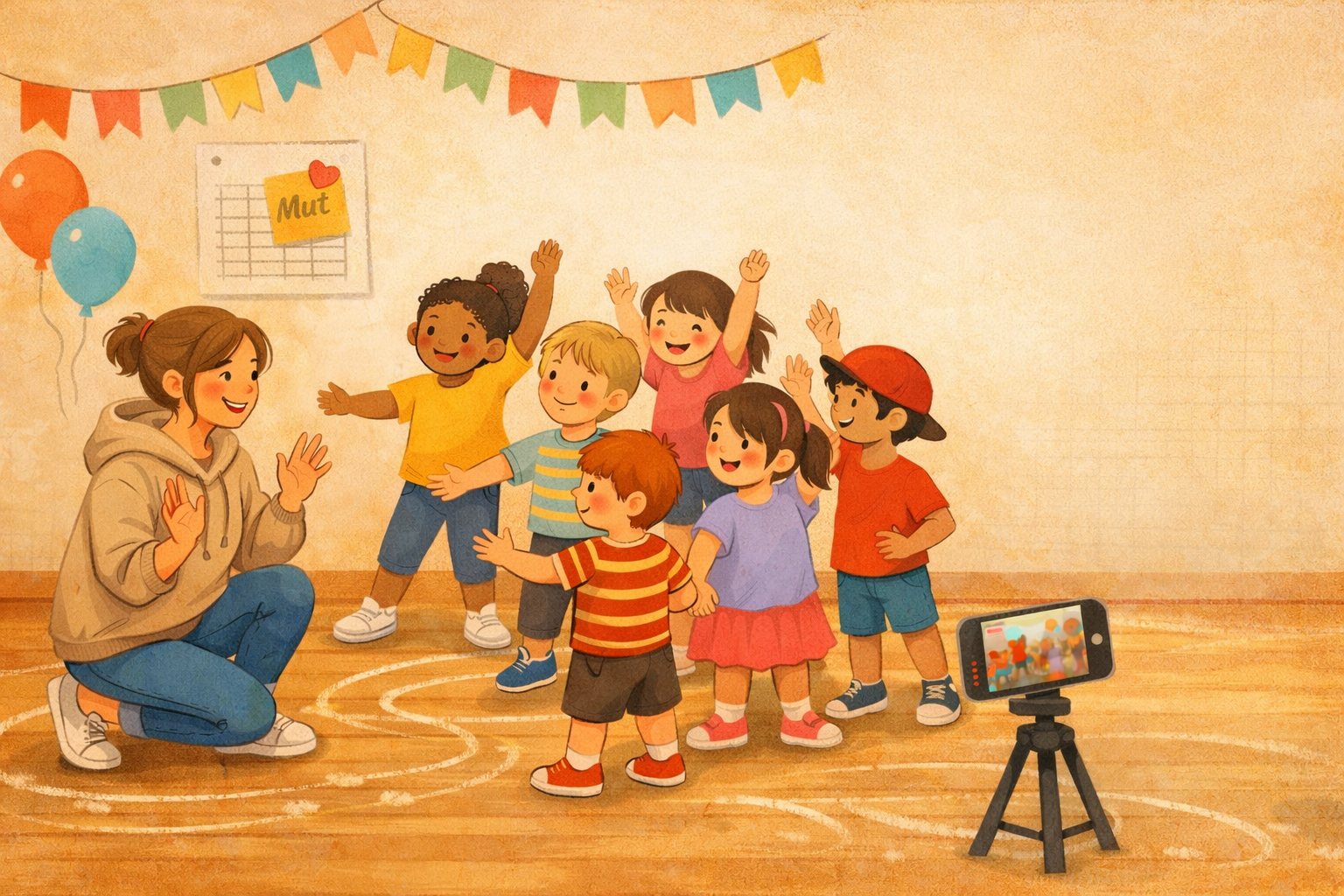
A young woman in her early 20s (Generation Z) gives courses on weekends in which children rehearse a simple but beautiful choreography together. At the end there is a performance or a video is recorded. But the decisive thing is not the choreography itself, but how it comes into being: the course instructor emphasizes that this is not about right or wrong like in school, but about joy, trying things out, carrying on. Small mistakes are part of it, no one should be disappointed if something doesn’t work right away.
Later – in a circle of adults – she formulates a thought that blows the frame: she experiences the performance system as “terrible”, especially because evaluations start very early. And she is not sure whether she even wants to “put” children into such an evaluation and performance society.
From this combination one can – with high probability, but without any claim to certainty – read a worldview: a kind of everyday philosophy that already contains the big (social criticism) in the small (children’s course).
In the following I will trace which life philosophy and which social socialization are most likely associated with this behavior – and how both fit into the larger context of school, performance, self-worth and Gen‑Z experience.
1) The observable signals: What she
does
and what she
says
Before interpreting, it is worth making a clean distinction between behavior and interpretation.
Observations (without interpretation):
- She works with children in the setting “celebration / community / performance”.
- She values a connecting choreography (community product instead of solo performance).
- She actively steers the mood: protection from disappointment, de-dramatization of mistakes.
- She explicitly distinguishes her setting from school: not right/wrong, but joy and moving on.
- She criticizes an evaluation and performance system (points/grades) that starts early.
- She links this criticism to an existential decision (to have children or not).
That is already a lot. Because what is visible here is not only a pedagogical style, but an image of humanity: a specific understanding of what a human being is, how learning works, and what makes a society sick.
2) The most obvious basic assumption: “A person’s worth does not depend on performance”
If you had to condense the whole thing into one sentence, it would probably be this:
People – especially children – should not derive their worth from evaluation and comparison.
That is the core. And from this core arise many conclusions that can be recognized in her course design:
- Mistakes are not a moral devaluation.
A mistake is not “you are bad”, but: “you are in the middle of the process”.
- Learning is not primarily a state of examination, but a state of practice.
The process is not the prelude to the result – it is the actual place of development.
- Community is not a ranking list, but connection.
A “connecting” choreography is a cultural counter-image to ranking.
In everyday life this is not only pedagogy, but already life philosophy: an attitude that places dignity before performance.
3) Her micro-ethics in the course: error-friendliness as a protective space
What she does in her course is – most likely – a deliberately designed “error culture”.
3.1 Error-friendliness is not leniency, but a learning logic
She does not seem to be simply “nice”, but to represent a specific logic:
- If children are afraid of mistakes, they learn worse.
- If they feel safe, they try out more.
- If they try out more, they get better.
This is a pragmatic pedagogy. And it is remarkable because it interrupts the most common short circuit of evaluation culture:
Evaluation creates motivation. – She would probably say: evaluation primarily creates conformity and fear, motivation arises differently.
3.2 The course as a counter-world to school
The statement “here it’s not about right/wrong like in school” is more than a comparison. It is a demarcation:
- School is experienced as a space in which mistakes are risky (shame, devaluation, consequences).
- Her course is meant to be the opposite: a space in which mistakes are normal.
In doing so she creates something that is often underestimated socially: she builds a different mode of reality. Not just a different activity, but a different basic rule.
4) The most likely image of humanity: humanistic, relationship-oriented, anti-shaming
If one derives an image of humanity from the behavior, the most likely classification is:
4.1 Humanistic basic attitude
Not “the human being is a project that must be optimized”, but rather:
- the human being is capable of development,
- needs security,
- and grows in relationship and self-efficacy.
4.2 Relationship orientation instead of enforcement
She does not seem to see relationships as a by-product of success (“if you are good, you will be recognized”), but recognition as the basis (“if you feel safe, you can grow”).
4.3 Anti-shame pedagogy
A central motive is: children should not “snap shut inside” when something does not succeed.
This is often a reaction to:
- shaming learning moments,
- excessive expectations,
- or early internalized norms of perfection.
Important: this does not mean that she is “traumatized” or the like – such diagnoses would be inadmissible and mostly wrong. It only means: she has a fine radar for the emotional side of learning.
5) Why dance of all things? Body, group, performance – as counter-grammar to evaluation
Dance is not just any medium. It fits her attitude surprisingly well.
5.1 Dance is practice without “written proof”
In dance there is no worksheet, no grade, no permanent documentation – but there is experience.
This fits a philosophy that understands learning not as proof, but as experience.
5.2 Dance makes mistakes visible – and thus de-dramatizable
A wrong step is immediately visible. You cannot “explain it away”.
Precisely for this reason it can be easily normalized: mistakes are part of the game, not the flaw of the person.
5.3 Performance as a shared high point, not as a court judgment
In a performance the moment is big, but not necessarily evaluative.
She apparently frames the end point so that it does not become an “exam”, but a “shared conclusion”.
This is a subtle but decisive reinterpretation: performance without performance pressure.
6) The social subtext: criticism of meritocracy and “evaluation logic”
When she says she is considering whether she wants to have children at all because the evaluation system starts so early, there is a strong social diagnosis in this:
Our society links belonging and self-worth to measurable performance – and starts this too early.
This is a criticism of a particular ideology that is often called “meritocracy”: the idea that “performance” can be measured fairly and then legitimately decides about opportunities, recognition and status.
With high probability she experiences this logic as:
- unfair (because starting conditions are different),
- dehumanizing (because it links dignity to output),
- and psychologically toxic (because it feeds shame, fear and self-optimization).
Her course practice is then not just “a nice hobby”, but a small-scale cultural counter-design.
7) Her generation as an amplifier: Gen‑Z socialization in a world of constant feedback
The fact that she is Generation Z is not incidental. Not because “Gen Z is like that”, but because certain social conditions make this attitude more likely.
7.1 Growing up in feedback systems
Gen‑Z socialization is often shaped by:
- digital metrics (likes, views, rankings),
- constant visibility,
- and permanent comparability.
This can greatly increase sensitivity to evaluation:
When the world feels like a permanent comment section, the desire for evaluation-free spaces becomes understandable.
7.2 Mental health as a public discourse
Compared to earlier generations, stress, overwhelm, performance pressure and mental health are discussed much more openly.
Many young adults have learned to see feelings and boundaries not as weakness, but as legitimate data about their own lives.
This fits exactly with her course style: not shaming, but regulating, carrying on, keeping joy.
7.3 Precarity and future skepticism
Many in this age group experience:
- uncertain job markets,
- high cost of living,
- crises as a permanent state.
This can lead to a basic attitude that asks:
“What are we actually slaving away for – and who benefits from it?”
Once this question is in your head, the school system quickly appears like the first training camp for a later never-ending evaluation loop.
8) Probability map: Which influences are
most likely
behind it?
To do justice to your wish “highest probability as a standard”, here is a heuristic: not a real measurement, but a plausible weighting of what are most likely the “gravitational forces” of her thinking.
(1) Dignity-before-performance / humanistic ethics (approx. 25%)
She protects children from disappointment and separates worth from performance.
(2) Errors-as-learning-path / process orientation (approx. 20%)
She explicitly frames the course as a practice space, not as an exam space.
(3) Criticism of evaluation culture / meritocracy skepticism (approx. 20%)
Her statement about having children goes beyond pedagogy – towards social criticism.
(4) Relationship and community orientation (approx. 15%)
“Connecting choreography”: belonging becomes visible as a central value.
(5) Gen‑Z feedback socialization (approx. 10%)
Experience of a world that constantly evaluates makes evaluation-free spaces valuable.
(6) Own biographical contact with performance pressure or perfectionism (approx. 10%)
This is plausible, but not certain. It would be a common source of such sensitivity.
The highest probability lies with 1–3: an image of humanity that protects dignity, understands learning as a process and views evaluation culture critically.
9) Life philosophy in everyday life: “Joy is not decoration, but resistance”
In many performance cultures joy is treated as a bonus: first comes duty, then you may have fun.
Her practice points more to a different philosophy:
- Joy is a criterion for a right life, not just a by-product.
- Play is not a waste of time, but a form of education.
- Community is not a means to an end, but meaning.
If you think like this, then school as it is often experienced is problematic: because it teaches a different grammar early on – the grammar of comparison, control and external evaluation.
Her courses are then not “dance lessons”, but miniatures of a different culture: a culture in which mistakes do not shame, but connect (because everyone is in the same process).
10) The hard point: desire for children as a moral question
The fact that she links the desire for children to society is perhaps the strongest indication of her worldview.
This says:
- She does not think only privately (“do I want children?”), but ethically-politically (“into what world do I put them?”).
- She experiences parenthood not only as personal happiness, but as responsibility – and as possible complicity with a system she rejects.
Here is a likely inner logic:
- School stands for society.
Early on one learns: worth = performance.
- Performance culture creates psychological costs.
Disappointment, fear, self-doubt are understood as systemic effects.
- Children would be exposed to this effect.
Parenthood then means: you hand a child over to a system that you find morally problematic.
- Consequence: ambivalent desire for children.
Not because she does not like children (she enjoys working with them), but because she wants to protect them.
This is a paradoxical but quite consistent position:
She apparently loves working with children – and precisely for that reason she doubts the system.
11) Where this attitude might come from: socialization between “you can be anything” and “you have to deliver”
Many young adults grew up with two contradictory messages:
- “You can be anything” (self-realization, individuality, talent, creativity)
- “You have to deliver” (grades, certificates, selection, competitions, applications, later KPIs)
This combination can create a specific tension:
- You are supposed to be “authentic”, but please successful.
- You are supposed to “unfold”, but measurably.
- You are supposed to “have fun”, but efficiently.
Her course philosophy seems like an attempt to resolve this tension – at least for one afternoon:
Unfolding without measurement.
12) The likely political classification: rather progressive, but essentially moral (not party-political)
It would be unprofessional to infer a party preference from a few sentences. But a likely value direction can be outlined:
- skeptical of neoliberal performance ideology,
- sensitive to mental health and social justice,
- rather “pro relationship, pro inclusion, pro education as unfolding”,
- critical of institutions that sort people early.
This is typical of progressive milieus in many countries and milieus – but does not necessarily have to be party-political. It can just as well be a moral rather than a political attitude: a sense of what is good for people and what harms them.
13) The blind spot that should fairly be mentioned
If you take her attitude seriously, you should also name the possible dark side – not as a refutation, but as a field of tension:
- Without any evaluation there is also no orientation.
Children (and adults) sometimes need clear feedback in order to improve.
- The world is partly performance-based – and children must navigate in it.
A total protective space can later lead to a hard break.
- It is not evaluation itself that is the problem, but the linking of evaluation to dignity.
You can assess performance without devaluing the person.
The mature form of her attitude would therefore probably not be “abolish grades at all costs”, but rather:
Detoxify, de-dramatize and decouple evaluation – so that learning can be learning again.
And that is exactly what she is already practicing in the course.
14) Larger context: we live in a “quantification culture”
If you take a wide view, her course is like a small island in a sea of numbers.
We evaluate a lot today:
- at school (grades),
- in the working world (goals, key figures),
- in the digital sphere (likes, followers, reputation),
- in everyday life (ratings, rankings, reviews).
The point is: evaluation is not just a tool – it quickly becomes a worldview.
If everything is supposed to be measurable, the immeasurable becomes suspect: joy, process, connection, play.
Her practice then appears as a counter-movement:
She defends the immeasurable – and thereby indirectly says:
A good life is not identical with an optimized life.
Conclusion: What is already contained in her course
With the highest probability there is a worldview behind this young woman that could be described as follows:
- Human dignity is inviolable and not tied to performance.
- Learning is a process that needs mistakes and cannot tolerate shame.
- Community arises through doing things together, not through comparison.
- Evaluation systems are not neutral, but shape self-images – often too early.
- Parenthood is not only private, but ethical: a decision about the relationship to society.
And perhaps this is the most interesting thing:
She does not speak against school because it is “bad”, but because she senses that a system that sorts too early will at some point sort more than just performance: it sorts people in their feeling of whether they are enough.
In her course she tries, at least for one afternoon, to practice a different message – wordlessly, step by step:
You are allowed to stumble. You belong. We carry on.