
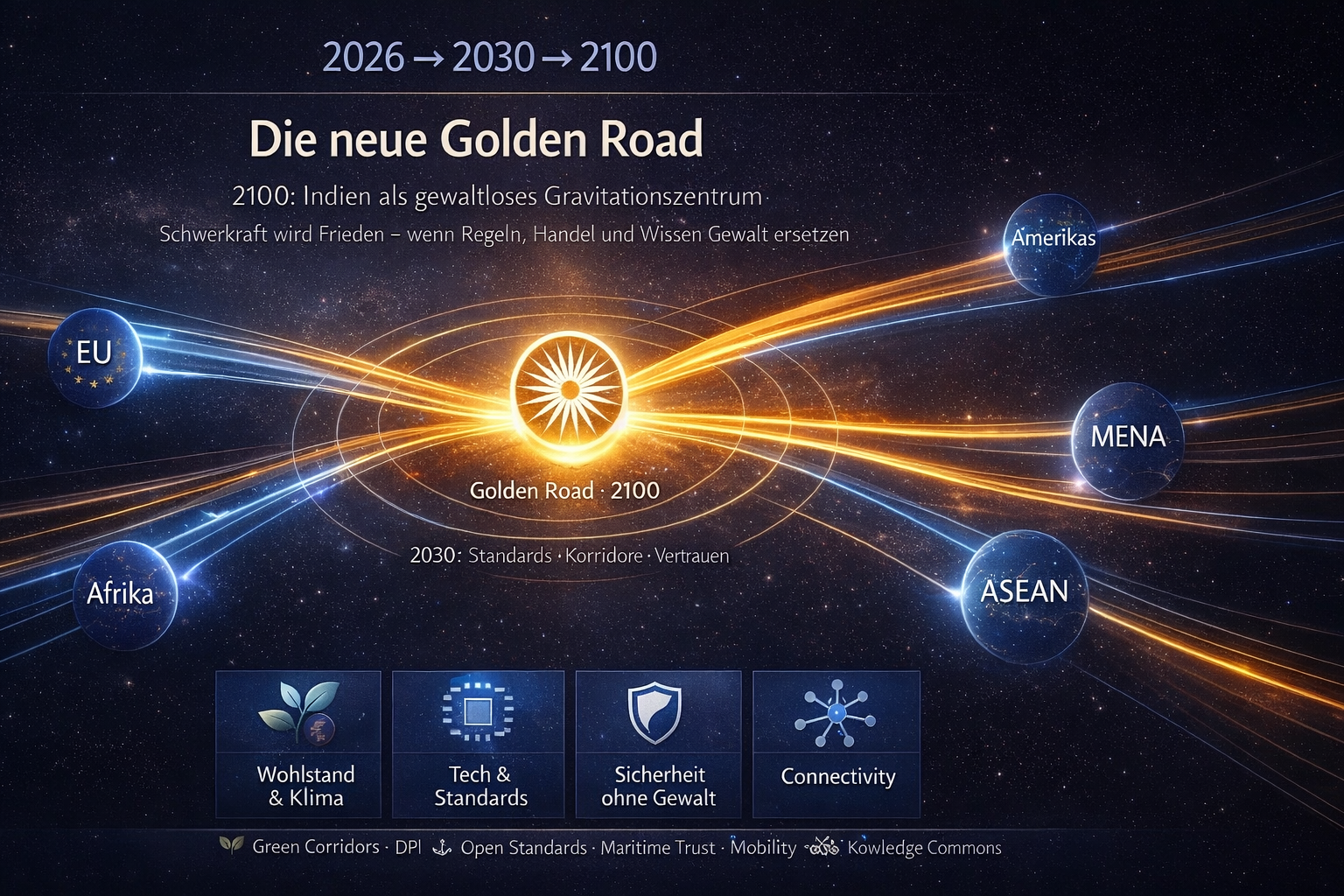
2023 → 2026 → 2100 – From demographic tipping point to civilizational architecture
My statistician heart laughed in article 1. My politics heart pointed to the bar in article 2.
Today I want to risk something that has become rare in our present: a vision that doesn’t sound like a commercial, but like a blueprint.
I call it: the new Golden Road.
Not as nostalgia. But as a reminder of a historical logic:
India did not create its greatest reach through conquest, but through trade, ideas, institutions, texts, faith, mathematics, art – in other words, through connectivity. No legions. No empire as a straitjacket. A center of gravity without occupation.
If that worked in the old days, the question for 2100 is not: Can India dominate?
But rather: Can India be a center that others orbit voluntarily – because it creates value, not because it creates pressure?
That is the difference between hegemony and gravitation.
1) What “center of gravity” even means in 2100 (and what it doesn’t)
By “center of gravity” I do not mean:
- “India decides everything.”
- “India is morally superior.”
- “India replaces America, China, Europe.”
I mean something more sober:
Center of gravity is the place where rivers converge:
Capital, data, standards, talent, energy, supply chains, dispute resolution, trust.
In the 20th century this convergence was strongly tied to dollar architecture, security architecture, institutions (USA).
In the early 21st century it was strongly tied to industrial scaling, supply chains, infrastructure (China).
In the late 21st century it will – if the UN curves are roughly right – be strongly tied to people, market, digital scaling, climate adaptation and rules (India as a candidate).
But: In a multipolar world a center is not the “boss”. It is the node you are reluctant to lose.
2) The “Golden Road” 2100 is not a road – it is a stack
If we want to understand 2100, we have to update the term road.
The new Golden Road is a stack of five layers that lie on top of each other:
- Physical connectivity
Ports, rail corridors, logistics software, maritime routes, resilience against climate damage.
- Energy connectivity
Electricity, hydrogen, green molecules, storage, grids, standards for guarantees of origin.
- Digital connectivity
Identity, payments, contracts, data spaces, AI interoperability – preferably as “public infrastructure”, not as a monopoly.
- Human connectivity
Education, research, visa pipelines, diaspora networks, talent mobility.
- Institutional connectivity
Arbitration courts, norms, regulatory compatibility, dispute resolution, anti-corruption, reliable enforcement.
The Golden Road is therefore not “where containers move”.
It is: where the future flows.
3) Why India of all places? Four hard reasons (without romanticism)
(1) Demographics as market and talent mass
If India is roughly at ~1.5 billion in 2100, then that is not just “big”. It is a permanent base mass: consumers, tax base, talent, founders, science.
(2) Geopolitical position as a bridge
Geographically, India is not a periphery. It is a bridge between
Gulf–Africa–Europe and ASEAN–East Asia, plus a natural anchor in the Indian Ocean.
(3) Legitimacy mechanism: democracy (with all its pains)
Democracy is slow, loud and often frustrating. But for a center of gravity the following applies:
Others find it easier to join if they believe that rules survive even when governments change.
That is the underestimated asset.
(4) “Global South” compatibility
Many countries in the 21st century do not want to play “West vs. China”. They want room to maneuver.
India can – if it is smart – be a center that does not proselytize, but connects.
And now comes the decisive sentence:
India will not be a center in 2100 because it “wins”,
but if it becomes the cheapest standard option for cooperation.
That was America’s trick. That can become India’s trick – nonviolent.
4) The price of the vision: nonviolent center means “delivery capability”, not “being good”
This is where it gets uncomfortable, because visions like to live in the clouds.
A nonviolent center of gravity only works if three things happen at the same time:
- Demographic dividend becomes productivity
Jobs, skills, health infrastructure, women in the labor market, urbanization that does not collapse.
- State capacity grows faster than complexity
Administration, courts, police, municipalities, data governance – otherwise “size” becomes congestion.
- Climate risk is managed, not suppressed
Heat, water, agriculture, coasts – without adaptation 2100 will not be a golden, but a burning century.
Nonviolent does not mean naive.
Nonviolent means: power is organized through dependence on value, not through fear.
5) What flows on the Golden Road 2100: five streams that build world order
If you want to know who gravitates in 2100, don’t look at tanks. Look at rivers.
Stream A:
Energy & molecules
- Green electricity from sun/wind + storage
- Green hydrogen/ammonia as transport molecules
- Standardized certificates (“green” is measurable, not marketing)
India can become a center here if it not only consumes, but exports production, standards and financing models: “This is how you make the energy transition scalable.”
Stream B:
Data & protocols
2100 is a world in which a country no longer only exports what it builds, but also how others build.
That is protocol power.
India’s historical strength was cultural connectivity.
The modern form of this is called: digital public infrastructure (identity, payments, signatures, open APIs) as a construction kit that other countries can adopt – just like script, numbers, narrative materials in the past.
Stream C:
Talent & education
The center of gravity attracts people – but above all it attracts ambitions.
If India is a magnet for research, entrepreneurship and solutions in 2100, then “brain drain” becomes “brain circulation”.
Stream D:
Supply chains & resilience
In the 22nd century the winner is not the cheapest chain, but the most resilient:
Diversification, transparency, insurance, climate robustness.
India can become a node here if it organizes “China+1” not as a transition, but as a system: with standards, ports, legal certainty, predictability.
Stream E:
Rules & dispute resolution
That sounds boring – and is the supreme discipline.
Whoever can resolve conflicts cheaply produces peace more cheaply than any defense budget.
2100 will not be peaceful because people are nice.
2100 will be more peaceful if contracts are enforceable and conflicts can be moderated.
A nonviolent India center would therefore also be a center for:
- Arbitration courts / commercial courts
- Technical standardization
- Anti-corruption compliance
- Interoperable regulation
Not glamorous. But strong in gravitation.
6) How the EU and India build a real “road” from this: the democratic double helix
If article 2 is correct, the EU-India summit 2026 is an attempt to turn gravity into direction.
The deeper point, however, is relevant for 2100:
- Despite aging, Europe brings an enormous density of regulatory competence, capital, mechanical engineering, research, rule-of-law institutions.
- India brings scale, talent mass, digital speed, market growth, strategic location.
That is a double helix:
Europe provides norm competence. India provides scaling competence.
Together they can build standards that are not only “Western” or “Chinese”, but connectable.
In the vision of the Golden Road 2100 the EU is not a “junior partner”, but:
- a stability anchor (law, institutions, high-end industry),
- a capital anchor (long-term financing),
- a standards anchor (measurability instead of assertion).
And India is the scaling and adoption anchor.
7) Nonviolent does not mean defenseless: security as a “common”, not as an empire
The Indian Ocean will not be less important in 2100 – rather more:
Goods, energy, data cables, migration, climate risks, piracy risks, conflicts over resources.
The classic solution was: a superpower “polices” sea lanes.
The Golden Road solution is: security is cooperatively industrialized:
- shared situational awareness (satellites, AIS, drones – as transparency, not as escalation)
- common coast guard standards
- anti-piracy protocols
- insurance and liability rules
- crisis communication
India can be a center here without playing empire if it builds formats that other states use voluntarily because they reduce costs.
Security as a service for trade. Not as a pretext for dominance.
8) The great trial: climate, water, heat – and the ethics of scaling
2100 is a climate century, whether we like it or not.
And India lies at the center of three hard realities:
- large population
- high climate vulnerability (heat, water stress, coasts)
- enormous urbanization
Therefore the Golden Road is decided not only in ports and data centers, but in:
- water governance (rivers, groundwater, efficiency, desalination, recycling)
- heat cities (construction methods, cooling, grids, health systems)
- agricultural transformation (resilience, nutrition, value creation)
If India solves these problems, it does not solve them “for itself”. It solves them as a blueprint for dozens of countries that will face similar challenges in 2100.
That is perhaps the most powerful soft power lever of all:
Whoever makes the future livable becomes the center.
9) 2100 scene: what an “Indian center of gravity” concretely feels like
Don’t imagine 2100 as a map of flags. Imagine it as everyday life.
- An entrepreneur in Nairobi founds a company because within 48 hours she gets access to digital identity, payment system, micro-insurance and export standard – all interoperable with EU market access.
- A mid-sized company in Poland integrates components from India, Vietnam and East Africa because supply chain compliance runs via common protocols.
- A port in Indonesia is part of a “green corridor” because fuel standards and guarantees of origin are compatible.
- A research lab in Bangalore co-develops climate models with Barcelona because data spaces and ethics standards fit together.
- A trade conflict does not escalate because there is fast, credible dispute resolution – and because all sides would lose more if they fell out of the system.
That is gravitation:
Not “India commands”, but India enables – and thereby becomes indispensable.
10) The bar from which this vision becomes real (and from which it fails)
Visions are cheap. Metrics are expensive. Here are ten (deliberately hard) indicators that determine whether the Golden Road 2100 is plausible:
- Job machine: does India create enough productive work over decades?
- Education & health: does quality rise, not just the rate?
- Women’s economy: does female labor force participation grow substantially?
- State capacity: do courts become faster, administration more reliable?
- Energy: does emissions intensity fall, does security of supply rise?
- Water resilience: does water planning become strategic, not ad hoc?
- Cities: do metropolises become livable or ungovernable?
- Digital infrastructure: does it remain open/interoperable instead of monopolized?
- Foreign policy: does India remain a bridge-builder instead of a bloc player?
- Institution export: do other countries voluntarily adopt Indian construction kits?
If the curves are right here, “Golden Road” will no longer be a metaphor, but a world order in operation.
Conclusion: the nonviolent center of gravity is not India – it is the system that India builds
I don’t want to end this series with a fairy tale, but with a sober punchline:
2100 is not won by whoever is strongest.
2100 is won by whoever builds a system that others do not want to leave.
The old Golden Road was a network of ports, monasteries, texts, ideas.
The new Golden Road is a network of energy, data, talent, standards and dispute resolution.
Demographics shift gravity.
Politics builds the orbit.
And nonviolent gravitation arises where value, rules and trust fit together.
India has the mass.
The world has the necessity.
Now it needs the architecture.