
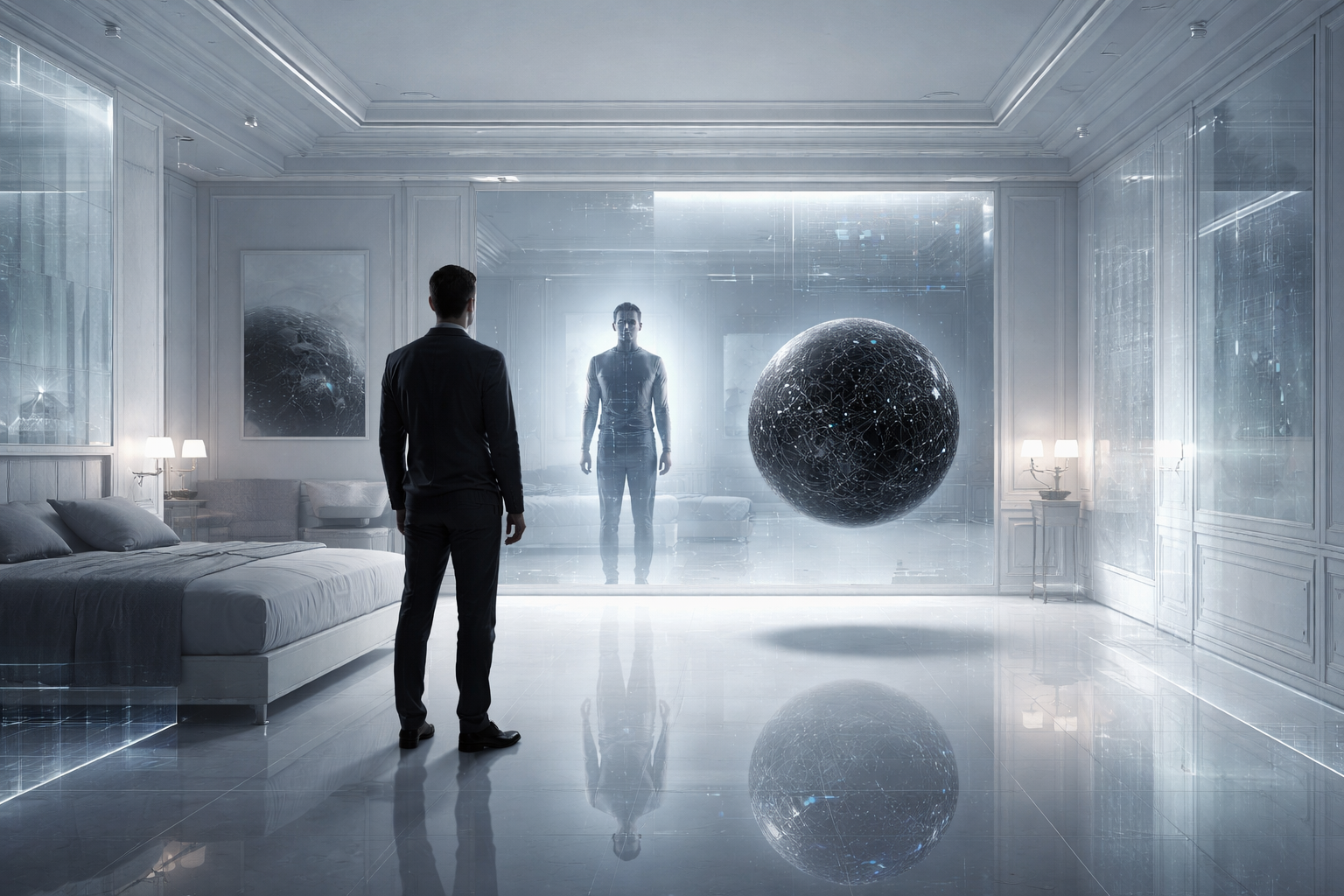
At the end of 2001: A Space Odyssey, Bowman does not simply fall out of the plot. He falls into a world that is obviously not “naturally” grown, but was built for him: a room like from a foreign memory of Europe, smooth, clinical, lit from below, as if someone had reconstructed “human coziness” from data and set it up as a stage. It is a habitat, a terrarium. It contains just enough familiarity not to shatter – and just enough strangeness to make it clear: You are no longer where you think you are.
What makes this room so disturbing is not only that it is unreal. But that it is a translation space. An intelligence that Bowman cannot explain has decided: A human can only stay here if his environment is cast into forms that his brain accepts. So the world is rendered for him. And while he moves within it, he watches himself aging, detaching from himself, until finally the last transformation occurs: the star child – a being that still looks human and yet is no longer human.
Now let us assume that the role of these “intelligences” does not fall to aliens, but to artificial intelligence on Earth – not as a mystical superpower, but as a real infrastructure of models, recommendation systems, generation, profiling, attention technology. Then Bowman’s room is no longer a science fiction backdrop, but a metaphor that moves uncomfortably close to our present: Each of us enters a room every day that is built for us. It is not called Louis XVI, it is called Feed, Timeline, For You, Discover, Autoplay, Search result, personalized homepage. It is the digital world that surrounds us – and that has become so self-evident to us that we hardly notice its construction anymore.
The decisive step in this analogy is: This world is not only displayed. It is computed. It arises from the logic: What captivates you? What confirms you? What keeps you here? The system does not have to “lie” to manipulate; it is enough that it selects. And selection is never neutral. It is always a cut through reality, a montage – like Kubrick’s film itself: you do not see “everything”, you see what is set. And because you see it permanently, it becomes the standard.
This is how the echo chamber arises: not as a thick concrete bunker of ideology, but as a soft, pleasant room that adapts to your viewpoint. It is warm, it is fitting, it is efficient. It delivers to you the version of the world in which you feel competent, confirmed, seen, attacked or saved – depending on what binds you. It is an acoustic architecture: You speak into it, and the walls answer with your own echo, only minimally varied, just enough for it to seem like “new information”.
And as with Bowman, the uncanny lies not only in the isolation, but in the sovereignty of the environment: You are no longer a subject that observes a world, but a subject to which a world is provided. The echo chamber is an individual cosmology that is stabilized around you – a personal universe with its own constellations: topics, objects of outrage, identity markers, enemy images, promises of salvation. You do not simply receive content, you receive a world order in miniature.
In Kubrick’s room, Bowman is observed, probably “well-meaning” kept. In our room, the observer is often more banal: metrics, business models, political actors, cultural dynamics. But the effect can be similar: You are not forced, you are guided. And guidance means: your possibilities are precomputed, your deviations smoothed, your surprises channeled. The echo chamber is not only echo, it is also training. It reinforces what you already do anyway until it feels like “nature”.
The second, even stronger thought in your thesis, however, is the feedback leap: The digital echo chamber does not remain digital. Because in practice – through time, attention, communication, consumption, politics – it becomes more dominant than immediate experience, it begins to shape physical reality according to its model.
This happens gradually and almost without a dramatic scene. It happens because decisions shift:
- We do not go where something is, but where it is displayed.
- We do not buy what we find, but what is suggested to us.
- We do not believe what we examine, but what sounds coherent in our world.
- We do not speak in order to understand, but often in order to remain visible in the system.
And because millions act this way, the echo chamber becomes not only a mirror, but a model that steers real resources. Companies no longer build products primarily for needs, but for visibility. Politicians no longer craft messages primarily for truth or complexity, but for resonance. Media no longer build stories primarily for enlightenment, but for throughput. People no longer build identities primarily for lived relationships, but for interpretable signals.
This is the moment when the real world becomes more similar to the digital room: not because someone “reprograms” it like in a sci-fi plot, but because the digital systems act like a gravitational field. What has weight there attracts matter here. What is rewarded there is repeated here. What is punished there is avoided here. This is not a conspiracy, it is an ecology of incentives.
Just as Bowman’s room is a translation of human reality into a foreign intelligence syntax, our physical world is increasingly being translated into a syntax that machines can process well: clear categories, unambiguous signals, fast reactions, binary affiliations, quantifiable behavior. And the more strongly this syntax controls the reward systems, the more the world adapts to it – until it seems to us as if it had always been this way.
In this reading, the monolith is not a black stone, but the invisible function that determines what counts: ranking, engagement, retention, conversion, reputation, score. The star gate flight is the moment when one crosses the threshold: from a shared world into a personalized one. And the Louis XVI room is the seemingly harmless surface on which this revolution takes place: pretty, smooth, understandable, “for you”.
And the star child?
Perhaps it is not the great elevation, but the new form of the human being that becomes plausible in this environment: the human as profile, as prediction, as digital twin, who no longer just lives, but is constantly being computed. A being that no longer experiences the world as a shared outside, but as a curated inner surface. That sounds bleak – but it does not necessarily have to be. For Kubrick’s image also contains an ambivalence: transformation can be progress. But it depends on who builds the room and for what.
The vision of 2001 begins as a cosmic leap. In our transposition, it threatens to become a quieter leap: away from the shared horizon, toward many private universes. And the decisive question is not whether the echo chamber exists, but whether we accept that it gains the primacy – until at some point the real world is no longer the corrective, but only the raw mass that adapts itself to the digital template.