
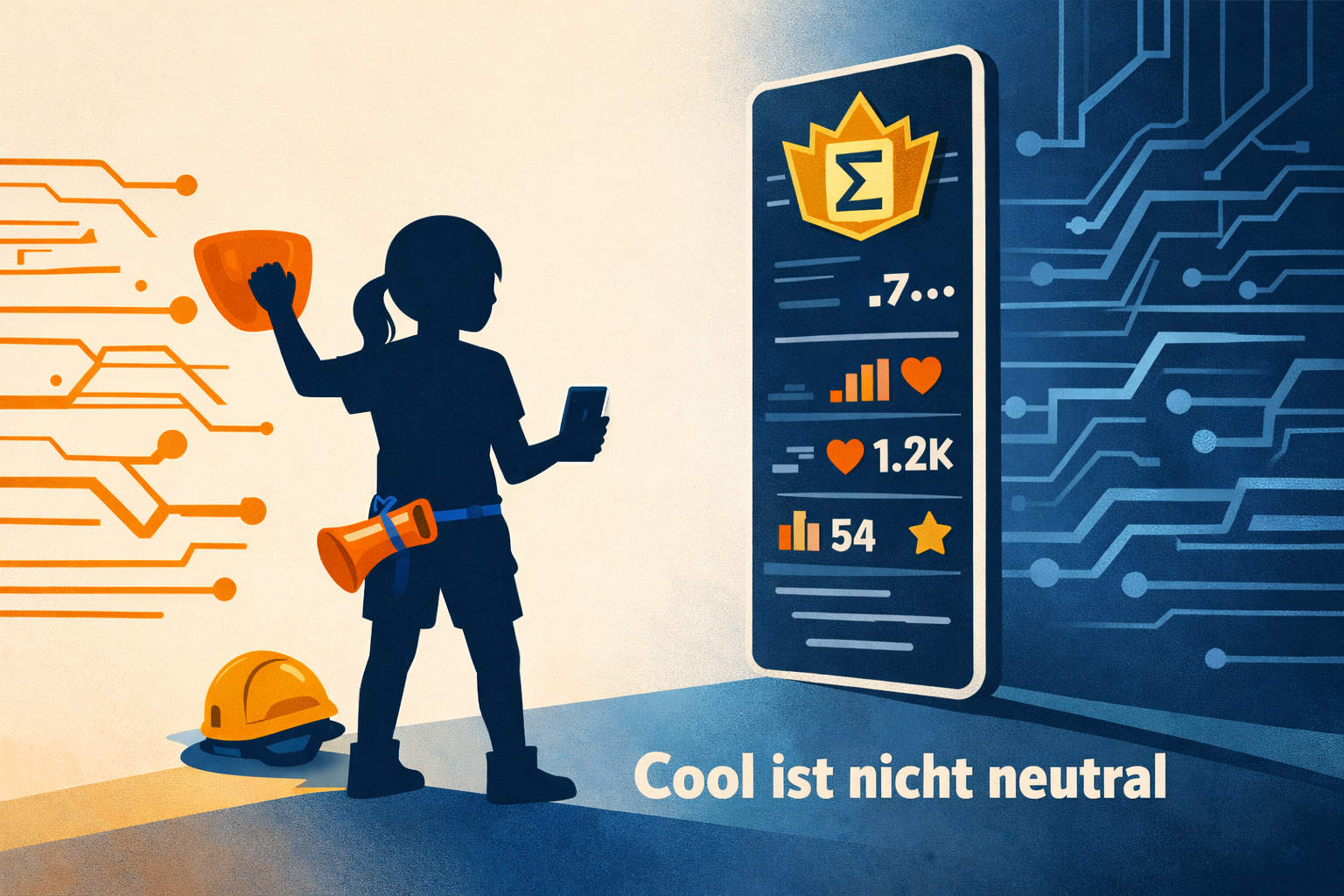
Why “Trend = Rank” is not harmless and what parents (especially fathers) can concretely do.
1) COLD START
I just asked her. Completely normal at the kitchen table, next to half-full cocoa and the little crumbs that in family apartments feel like their own state of nature.
“What do you actually find so cool about this ‘Sigma Boy’?”
She looks at me as if I had asked whether water is wet. Then she laughs briefly and says: “He’s just cool.”
Not “I like the song.” Not “the beat is good.” Not “that’s funny.” But: Him. The boy. The figure. The title. The label.
And then suddenly it was there, this strange fatherly mixture of fascination and alarm. Because in recent weeks and months I have placed a lot of hope in one thought: That Generation Alpha might program the patriarchy out of their reality. That my daughters grow up in a normality in which no one can say anymore: “A girl can’t do that” without it sounding like a fossil.
And then this child sits in front of me, eight years old, and I see how a meme sound slips into her system like a small, harmless app – and how it reactivates something very old: Rank. Gaze. Evaluation. Attractiveness as hierarchy.
What if patriarchy doesn’t come back today as a prohibition – but as an earworm?
⸻
2) THESIS (short, hard)
“Sigma Boy” is not the enemy for me. It is a symptom. A very modern, very efficient symptom.
• “Sigma Boy” is not an isolated case, but a meme wrapper for role codes.
• TikTok is not just entertainment – it is an evaluation system. Trend is rank, rank is orientation, orientation becomes identity.
• Evaluation eats courage. And courage is the lever against patriarchy.
In my text about patriarchy I wrote: “Patriarchy is an operating system.”And systems do not change because you politely ignore them. They change when you rewrite the code in everyday life: responsibilities, language, role models, boundaries, courage.
What hits me about “Sigma Boy” is the suspicion: Another system is writing along here. Quietly. Quickly. High-frequency.
[TILE-SENTENCE 1] When “cool” becomes a judgment, courage becomes the exception.
⸻
3) MECHANICS: HOW THE SONG CARRIES PATRIARCHAL CODES (3 mechanisms)
M1) Rank label instead of relationship: “cool” = higher status, not better connection
Explanation (systemic):
“Sigma” is – as an internet observation – often not a relationship term, but a rank term. A label that says: above. Independent. Unimpressed. Not needy. Not reliant. Not vulnerable.
And with that, the logic shifts from: “Who suits me?” to: “Who is above me – and is therefore desired?”
This is a basic movement of patriarchal systems: value does not arise through relationship, but through position.
Example (child/everyday life):
When my daughter says “he’s cool”, she doesn’t mean: “He is kind” or “He listens.” She means: “He has this status that everyone sees.”
And that is exactly the point: the status is public. It does not belong to intimacy, but to the stage.
This is how role learning does not begin with morality, but with orientation: Who is on top? Who is allowed to take up space? Who is admired?
M2) Untouchability as attractiveness: emotionally distant hardness becomes the ideal
Explanation (systemic):
Patriarchy loves the idea of untouchability. Not necessarily as brutality, often as a pose: I need nothing. I show nothing. I am not dependent.
This is compatible with a male ideal that codes empathy as weakness and closeness as risk. And it is compatible with a female socialization that often learns: recognition is received by those who impress “the cool boy” – that is, those who measure themselves against him.
Example (school/online):
Children learn early how embarrassing it is to show “too much”. Too enthusiastic. Too sad. Too in love.
When a label “Sigma” then lies around as a cool superego, it is an invitation: Become untouchable, then you are safe.
The problem is not that children have fun with music. The problem is that untouchability becomes a safety strategy – and that is poor ground for equality, because equality needs relationship.
M3) Audience effect: girls validate the “value” of the boy (man = prize, woman = jury)
Explanation (systemic):
This is where the most sensitive point lies for me: many pop meme frames work in such a way that the boy is staged as the “prize” – and the girls (or the audience) confirm his value.
This is not “girls are to blame.” This is system logic: when value runs through visibility and rank, recognition becomes currency. And those who distribute recognition become part of the market.
Example (child/media):
My daughter does not say: “I like how he deals with people.” She says: “He’s cool.”
That is a judgment, not a feeling.
And when eight-year-old children start to learn attractiveness as a judgment, they also learn – incidentally – that relationship is something you earn, instead of something you shape.
⸻
4) WHY THIS HITS MY HOPE (bridge to my patriarchy article)
In my patriarchy text, I was concerned with this quiet DNA:
“I evaluate you – and you have to respond to it.”
Not always aggressive. Sometimes friendly. All the more effective for that.
And I wrote: “Equality does not begin in parliament, but at the kitchen table.”
I stand by that. More than ever.
But I realize: the kitchen table is no longer the only place where operating systems are written. TikTok – as a feed, as a trend machine, as an evaluation space – writes along. And not in long parenting lectures, but in ten seconds. In repetition. In sound.
My hope was: Generation Alpha makes patriarchy old.
My fear is: patriarchy has learned to sound young.
Not as a “A girl can’t do that” sentence, but as: “Sigma is cool.”
And that is perfidious, because it doesn’t look like sexism. It looks like entertainment. Like dance. Like fun. Like “it’s just a song.”
Yes. And that is exactly why it is so effective.
⸻
5) EVALUATION SYSTEMS: TIKTOK AS A COURAGE BRAKE (without panic)
I don’t want moral panic. TikTok is not “evil”. It is an infrastructure.
And infrastructures have logics.
The logic here is: Attention is rank. Rank is visibility. Visibility is value.
That is not “wrong”, it is just dangerous when children build their identity from it.
Because courage is usually the opposite of rank logic:
Courage means doing something before there is applause. Courage means embarrassing yourself without dying. Courage means not knowing whether you will end up on top or at the bottom – and speaking anyway.
But if “cool” is the invisible grade, then courage becomes expensive.
How you notice that evaluation eats courage (5 signals):
• Children ask less: “What do I want?” and more: “What goes down well?”
• “Embarrassing” becomes a stop signal, not a learning signal.
• Mistakes are hidden instead of tried out.
• “Cool” replaces “kind”, “brave”, “fair” as the most important category.
• Roles are imitated because deviation is a risk.
And now comes the uncomfortable part: I don’t just notice this in children. I notice it in myself too.
Self-observation (father, honest):
I myself slip into evaluation when I actually want to encourage courage. I quickly praise the result (“wow, really good!”) instead of the attempt (“you dared”). I want to protect her from embarrassment instead of making her immune. Sometimes I want her to “come across well” instead of becoming clear. That is not malice. That is a reflex. And that is exactly why it is an operating system.
[TILE-SENTENCE 2] Patriarchy today does not come with prohibitions – but with rankings.
⸻
6) WHAT DAUGHTERS LEARN FROM THIS (without assigning blame)
I don’t want to “save” my daughter from the internet. That is not realistic – and it would also be an illusion of control that can itself be patriarchal again: father as gatekeeper, daughter as project.
What I want is: to give context. To build coordinates.
Because in an evaluation system, girls often learn an additional lesson:
Not just “be good”, but “be good and be pleasant while doing it”.
This is the perfection trap that I named so clearly in my article:
“You don’t have to be ‘perfect’ to be taken seriously. Because perfection is often the price girls are supposed to pay in order to get any space at all.”
When a meme label like “Sigma Boy” appears as a cool center, the following can (as a hypothesis) result from it:
• Adaptation as a strategy: “How do I become acceptable for the cool gaze?”
• Giving up space as safety: “Not too loud, not too much, otherwise cringe.”
• Desire as hierarchy: “Those who are on top have value – not those who are good to me.”
• Courage as an exception: “I only take risks when I am sure that it will go down well.”
And that is exactly where it hits my hope. Not because my daughter likes a song. But because I see how early attractiveness as judgment enters the system.
⸻
7) WHAT BOYS LEARN FROM THIS (short but central)
In the patriarchy text I wrote: the system also harms boys and men – but not symmetrically.
What boys can learn from rank memes (as a hypothesis):
• Hardness becomes currency: Those who are unimpressed win.
• Distance becomes status: Those who need less stand higher.
• Empathy becomes a risk: Those who feel can lose.
This stabilizes patriarchal patterns because it makes relationship more difficult. And equality without relationship is just a word.
If boys learn that “Sigma” is cool, and girls learn that “Sigma” is desirable, then a perfect circle emerges: Status produces desire, desire confirms status.
This is a feedback loop, not a character flaw.
⸻
8) KITCHEN TABLE: 10 CONCRETE MINI-INTERVENTIONS (very concrete)
1. I ask about the “why” behind “cool”.
Not as an interrogation, but as training: “What exactly do you find cool – voice, dance, outfit, behavior?”
2. I introduce new categories: “fair”, “brave”, “kind”, “clear”.
If “cool” remains the only currency, rank logic automatically wins.
3. Father action: I make responsibility visible (not just opinion).
Not “helping” with care work, but taking it on – so that role models are not negotiated only in the feed.
4. Father action: I practice “courage praise” instead of result praise.
“You dared” is stronger than “you were good”.
5. I build “embarrassment immunity” as a game.
We deliberately do small silly things so that the system learns: embarrassing is not dangerous.
6. Father action: I stop my own mansplaining in the moment.
When I want to correct, I first ask: “How do you mean that?” – so that her voice gets space.
7. I talk about trends like about weather: real, but not almighty.
“That is everywhere right now” is an observation – not a judgment about its value.
8. Father action: I actively curate role models (books/series/music) – and discuss them.
Not forbid, but compare: “What roles do you see here? Who is admired – and why?”
9. Consent/autonomy as an everyday attitude: no is complete.
Even with small things (tickling, hugging, photos): a no is not negotiated.
10. I relieve my daughters of repairing the world.
I explicitly say: “You don’t have to solve this. I am learning too – and I am building too.”
⸻
9) CONCLUSION: HOPE WITHOUT BURDEN ON CHILDREN
My daughter is allowed to find “Sigma Boy” cool. Really. I don’t want to turn every earworm into a tribunal.
But I also don’t want to pretend that an earworm is just an earworm.
Because in a world in which evaluation systems are everywhere, earworms are sometimes transport vehicles. Not for “messages” in the poster sense. But for orientation: Who is on top? What is desirable? What is embarrassing? What is brave?
My hope for Generation Alpha is not dead because a TikTok sound is viral.
But it will only become real if we understand: the operating system does not write itself in the right direction.
And if I really want to take one sentence from my patriarchy text seriously as a conclusion, then this one:
Not someday. Today. At the kitchen table. In the tone. In the responsibility.
We don’t have to hide children from the world.
We have to help them become free in it.