
Today I am starting the production of “Kaleidokosmos: The Morgenstern Brothers” — not as a firework, but as a workshop operation.
Entry: Saturday, January 24, 2026, 18:45
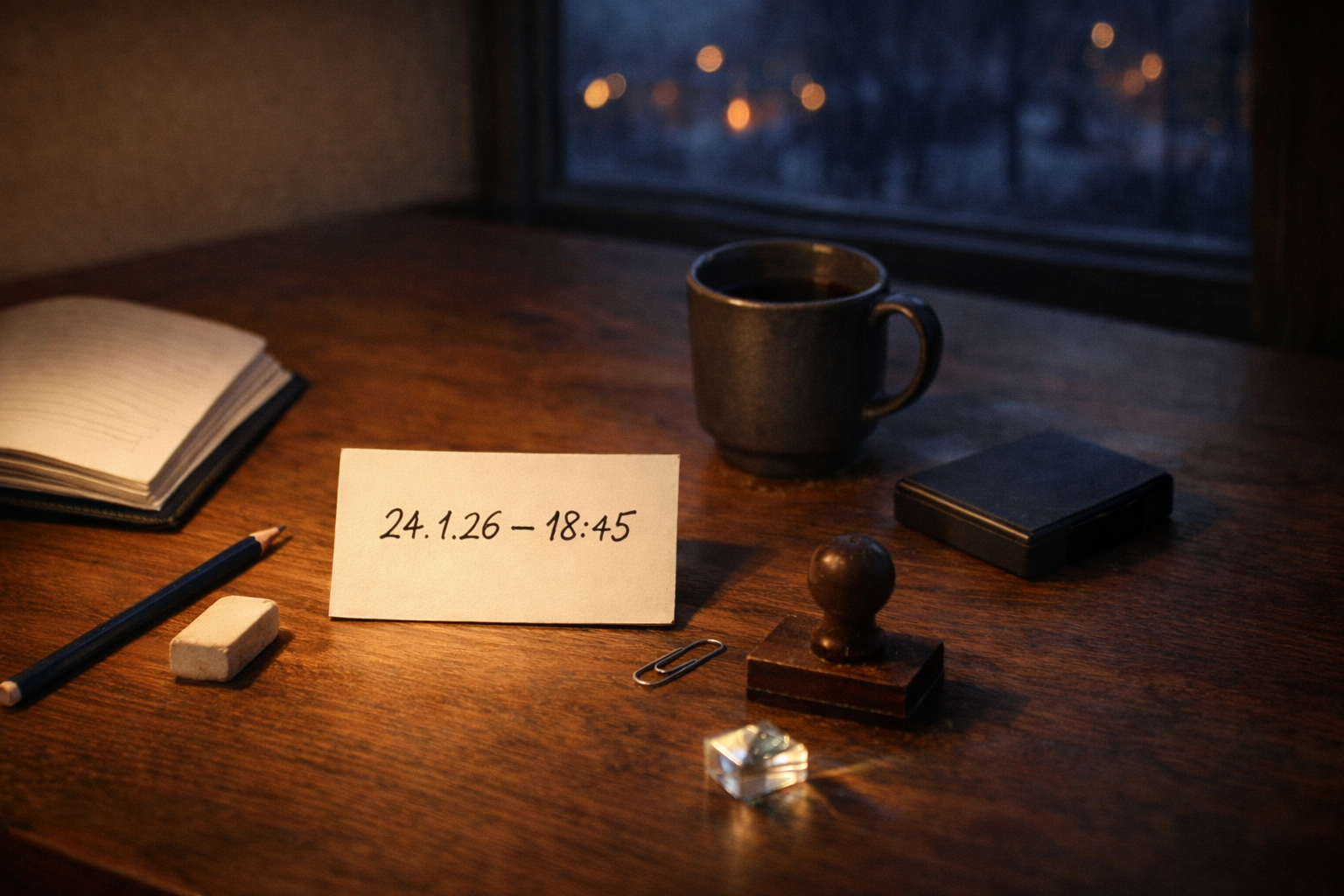
At 18:45 the apartment is quiet enough that the ticking of the heater becomes a kind of metronome. Outside: winter light that no longer shines, but only clings to the windows. On the table lies an index card, too big for what it is supposed to carry, and yet just right: “24.1.26 – 18:45” is written on it, crooked, as if the hand had briefly hesitated over whether it is really allowed to nail this down.
Next to it: a notebook, a pencil, a cup that has long since gone cold. These are not big symbols; they are objects that keep my gaze from drifting into the vague. I sit down, place the index card on top like a lid — and say it out loud once, so that it stays in the room: Now the production begins.
If you write, you may know this strange moment: not “inspiration”, more a decision that disguises itself as a manual gesture. You straighten a sheet of paper, adjust the chair, and with this banal gesture of order you also straighten an inner boundary. Before: talking. After: work.
Why now / why this book
So why a second novel — and why this one?
I want to write a book that shows how ascription becomes persecution: how someone is declared to be something they are not, and how institutions manage, store, repeat this declaration — until it feels like truth. First someone is declared “Jews”, although he lives as a Christian; later he is declared “Germans”, behind the Iron Curtain. These are not labels in a vacuum. They are actions, violence cast into language, often cold, often bureaucratic, often with a stamp.
And I want the reader to notice: This does not happen in the fog of grand history, but at interfaces. At counters. In forms. In files. In glances that suddenly no longer see, but assign. Perhaps you know this in a smaller form: a sentence that pins you down to a role; a file that knows more about you than you do; an algorithm that puts you in a category while claiming to “only measure”.
“Kaleidokosmos: The Morgenstern Brothers” is meant to be a novel that changes scale without fleeing into a lecture: I ↔ institution ↔ world time/2100 ↔ lifetime. Not as theory, but as scene. Not as digression, but as an object that lies in the hand.
What this book does not do
This book will not retroactively explain or smooth out roman1. It will not break it.
It will not claim new historical facts just because details “sound good”.
It will not spill private side-worlds that have no place here.
It will not diagnose characters and stick psychology on them like a label.
It will not glorify suffering and will not prescribe to anyone that they “must find meaning”.
It will not show off with future predictions; 2100 will appear only where a scene can carry it.
It will not explain where it can show — and it will remain silent where explanation would become degradation.
That is the agreement. Not as morality. As craft.
How I work: the workshop operating system in 15 steps
So that the book does not consist of ideas but of viable scenes, I work with an architecture that restricts me — and precisely thereby sets me free. In a comprehensible short version it looks like this:
- Setup: employment contract with myself, fix rules, create STATE — no text yet.
- Canon extraction: build a whitelist from roman1 and mandatory material: What am I allowed to say? What must I avoid?
- Planet statement: clarify in one sentence why this book exists — without plot, without excuses.
- Book architecture: plan prologue, chapters 1–N, epilogue: each unit has function, place, object, scale.
- Object & motif network: define things as meaning storage, plan recurrence, prevent decor.
- Prologue PREP: prologue as blueprint: beats, objects, truth interface, ethics gates.
- Prologue WRITE: write prologue — strictly according to blueprint, no new claims.
- Chapter-k PREP: for each chapter a blueprint: plot lines, objects, institution, scale, no-new-facts check.
- Chapter-k WRITE: write chapter — then decide: continue, checkpoint or revision.
- Checkpoint: every 2–3 chapters: condense, stop overloading, update object logic.
- Red team: activate toughest criticism: tone drifting? Ethics violated? Object just decor? Canon breach?
- Epilogue PREP: blueprint epilogue so that 2100/lifetime becomes scenic, not preachy.
- Epilogue WRITE: write epilogue — likewise strictly, without future-data fireworks.
- Consolidation: continuity & motif sweep: contradictions, jumps, fact risks, revision tickets.
- Packaging: output manuscript cleanly + index (objects/realia) for later maintenance.
If you read this and think: “That sounds like bureaucracy” — yes. But it is the bureaucracy I need in order not to write into bureaucracy. A framework so that the house is not just a façade.
What matters to me ethically
I am writing this book under an ethic that cannot be preached without betraying it: meaning is not an obligation. Meaning is not a bravery bonus. Meaning is not something you slap onto suffering so that it becomes “somehow good”.
If something like meaning appears in this novel, then only as a form of response: as action, as attitude, as language that refuses to reduce the human being to a label. And at the same time: as an acknowledgment that one can break — without guilt, without moral devaluation, without the secret “you just should have reacted correctly”.
This has consequences for every single scene. It forces me to watch my sentences. Not to show in order to show. Not to describe in order to possess. Not to “explain” where explanation would become exposure. You may notice: This is not a theoretical guideline. This is a manual grip on the sentence.
And it also forces me not to caricature institutions as villains. Institutions are often not “evil”. They are tools that stabilize language: forms, files, stamps, accounts, lists. Truth is administered. Money is administered. Guilt is administered. Identity is administered. And that is exactly the point at which literature can become concrete without fleeing into data.
Objects as meaning storage
Perhaps this is the core of my craft: I trust things more than claims. Things do not lie — but they can be used to stabilize lies. That is why objects in “Kaleidokosmos” are given a supporting role. Not as “symbolism”, but as storage.
- An ID card: not “paper”, but a portable claim about you. In your pocket: small. At the counter: world power.
- A stamp: a sound, an imprint — and suddenly a statement has become an administrative act.
- A suitcase: not just luggage, but a decision about lifetime: What may come along? What stays? What is confiscated?
- A letter / a note: language that is on the way, endangered, interceptable — and at the same time the thinnest form of closeness.
- A file: a bundle of paper that outlasts you, reduces you, transports you even when you are not present.
Such things allow me to change scale without lecturing. An ID card can be “I” and “institution” at the same time. A file can cut into lifetime and still lie on a shelf. And if 2100 appears at some point, then not as statistics, but as something you can touch: an archive box, a digital access, a trace that remains — or is deleted.
Outlook without deadlines: invitation
What happens next? I will stick to my own architecture. I will first sharpen the rules, keep the sources clean, build the object index before I call the first sentence “novel text”. That sounds slow, but it is my form of speed: fewer detours, less retroactive rescuing, fewer beautiful sentences that carry no responsibility.
And if you feel like it, you can accompany this. Not as a countdown, not as a promise, not as a “journey”, but as workshop light that is still on in the evening. Write to me in the comments what interests you about such processes — or what you as a reader are allergic to when books talk “about truth”. If you like, follow the blog or subscribe to the newsletter so as not to miss the next workshop notes. Without pressure. Without “you must”. Only as a possibility to stay attentive together.
I turn the index card between my fingers once more, as if I had to check whether the ink holds. 24.1.26 – 18:45. A date that proves nothing but opens something. Then I open the notebook.
Now the production begins.