
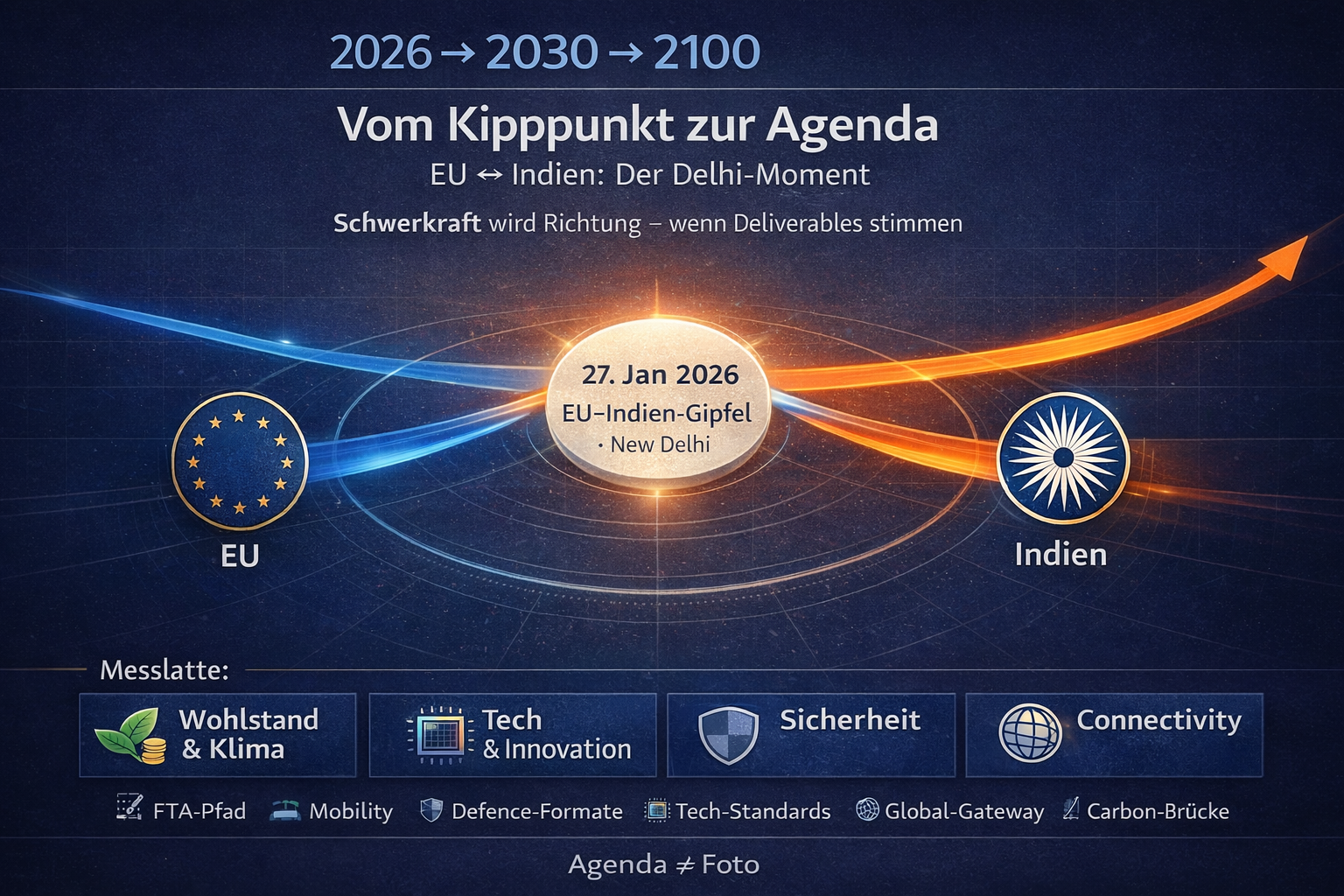
The EU–India summit on January 27, 2026 in New Delhi – and the benchmark for its success
Yesterday the curve was the main character: India overtakes China – a demographic tipping point that shifts global gravity.
Today the curve is only the background. Because gravity alone does not create order. Order emerges where interests, standards, capital, technology and talent flows can be translated into concrete architecture: into contracts, programs, investments, rules, timelines.
That is precisely why Republic Day week in India 2026 is more than protocol: on January 26, the President of the European Council António Costa and the President of the European Commission Ursula von der Leyen will take part as guests of honor in the celebrations of the 77th Republic Day – for the first time in this form for the EU leadership.
And on January 27 they will co‑chair, together with Prime Minister Narendra Modi, the 16th EU–India summit in New Delhi.
If you believe in 1945–2025–2100 (and not only in the news cycle), then this is one of those rare moments when you can measure politics by its long‑term viability.
1) Why this summit is a “second tipping point”
The first tipping point was demographic: India is no longer “the next big country”, but the country that numerically carries the world in the 21st century. According to UN projections (WPP 2024, medium variant), India will continue to grow for decades, reach a peak of around 1.7 billion around 2061, and still be at about 1.5 billion in 2100; China falls over the same horizon to 633 million.
The second tipping point is political:
Whether this gravity is translated into stability, prosperity and legitimate order will be decided less by birth rates – and more by the ability to build partnerships in such a way that they scale.
And yes: in the global demographic picture the EU is the counterpole – a highly productive, rule‑setting market, but with aging as a structural issue. The EU population stood at 450.4 million on January 1, 2025 (Eurostat) – growth recently mainly through migration, not through natural increase.
This is not a disadvantage, but a framework: Europe must defend its competitiveness in a world in which “more people” happen elsewhere.
2) The context: More than symbolism, less romance
The trip has been communicated as a State Visit January 25–27, 2026, including meetings with the Indian leadership and an expected India‑EU Business Forum on the margins of the summit.
And the EU side is deliberately setting a broad agenda: Trade, Security & Defence, Clean Transition, People‑to‑People.
This is not a random list of topics. It is an implicit diagnosis:
Prosperity in the 21st century is not just GDP – it is resilience (supply chains), rule‑setting (standards), talent mobility, security of sea lanes, technological sovereignty.
If that is true, then this summit is not a “nice meeting”. It is an attempt to define a new orbit.
3) The hard number behind the nice word “partnership”
Partnership sounds soft. Trade is hard.
The official EU figures show:
- Goods trade EU–India 2024: over €120 bn (EU imports €71.4 bn, EU exports €48.8 bn)
- Services trade 2024: over €66 bn (EU imports €37.4 bn, EU exports €29.2 bn)
- EU FDI in India 2024: over €132 bn, over 6,000 European companies in India, around 3 million jobs
- Connectivity / Global Gateway: the EU and Member States have pledged > €15 bn for projects in India for 2021–2025.
These figures are important because they mark the real issue:
An economic orbit already exists. The question is whether it now gains strategic depth.
4) The official blueprint: Four pillars – or four tests
The EU side expects that a “joint EU‑India comprehensive strategic agenda” will be adopted – with four priority areas:
- Prosperity & sustainability
- Technology & innovation
- Security & defence
- Connectivity & global issues
You can read this as PR. Or as a checklist by which the summit can still be evaluated in five years. I suggest the latter.
5) What Europe rationally wants (without moral packaging)
Europe has three strategic needs – and India fits all three:
(1) Resilience through diversification
When supply chains become geopolitical, “dependence” becomes a price factor. Europe needs more than a “China‑or‑nothing” ecosystem.
(2) Standards with weight
Whoever sets standards in tech, data, industry and climate does not just write rules – they export power in the guise of norms.
(3) Order policy / “rules‑based” as self‑interest
Not because Europe would be “better”, but because a system of rules, legal remedies and reliability is cheaper for open economies than a system of threats, tariffs and vulnerability to blackmail.
The fact that the EU is explicitly framing the summit as a contribution to protecting the “rules‑based international order” is therefore not pathos, but interest‑driven policy.
6) What India rationally wants (and why Europe is relevant for it)
India’s demographic dividend is not an automatic return. It is an investment decision – under time pressure.
India typically wants (and needs) to:
(1) Scale jobs & productivity
More people only become an advantage if they can become productive – through education, industry, services, infrastructure.
(2) Market access in a high‑price market
An FTA with the EU is not “Western prestige” for India, but potentially a lever for export upside, especially in sectors such as textiles, electronics, chemicals. Reuters reports that both sides expect an announcement on the conclusion of the FTA negotiations at the summit on January 27.
(3) Technology & capital – without strategic dependence
India is seeking cooperation that enables growth but remains politically autonomous. Europe is more interesting for this than many believe: large enough, rule‑based enough, and (importantly) not only a “security partner”, but an investment and standards partner.
7) The benchmark: Six outcomes by which the summit can be measured
If this summit is to be historic, then not because of the backdrop, but because of deliverables. Here are six outcomes that define a “best possible result” – from the perspective of both sides.
Outcome A: FTA – not just “progress”, but a path to signature
The negotiations have officially been running since 2007 and were restarted in 2022.
The best case is therefore not another “we are optimistic”, but at least:
- political agreement on conclusion or binding roadmap (legal scrub → signature → ratification)
- plus a mechanism for how sensitive chapters (e.g. cars, regulation) will be finally decided.
Outcome B: Carbon / regulatory bridge (CBAM & co.) – compatibility instead of permanent crisis
Reuters explicitly names EU carbon levies and other non‑tariff barriers as a sticking point.
The best case would be a technical path: reporting compatibility, transitions, cooperation on measurement and verification standards – so that climate does not become a trade war.
Outcome C: Security & defence – from talks to formats
The EU side emphasizes security & defence as a top agenda item and speaks of a security & defence partnership to be pursued.
Reuters also reports expectations that a security / defence agreement could be signed in parallel with the summit.
The best case would be: fixed dialogue formats, maritime cooperation, protection of critical infrastructure – i.e. “operationalizable”, not just “shared values”.
Outcome D: Mobility – talent as strategic currency
Reuters mentions an expected mobility agreement for highly qualified workers and students.
The best case would be: clear programs, recognition / visa facilitations, and “people‑to‑people” not as a cultural program, but as a strategic pipeline.
Outcome E: Connectivity / Global Gateway – projects you can point to on a map
There are already pledged > €15 bn (2021–2025) in the Global Gateway context.
The best case is an update: new project pipeline (digital, energy, transport) with timeline, financing structure and ownership – no pure declarations of intent.
Outcome F: Tech & innovation – joint standards instead of parallel ecosystems
The summit frame explicitly names “technology & innovation” as a pillar.
The best case would be a handful of visible pilot projects: interoperable digital infrastructures, trustworthy data spaces, joint research priorities – where both sides can combine scale and legal frameworks.
8) The four friction points that cannot be smoothed away
Seriousness means: you name the lines of conflict before they later tear you apart in implementation.
- Cars & industrial tariffs: India’s reluctance on strong tariff cuts on car imports is described as a point of contention.
- Carbon costs / CBAM: Indian concerns about EU carbon levy mechanisms are explicitly mentioned.
- Non‑tariff barriers & regulatory density: when standards become market access barriers, political resistance arises – even when there is economic benefit.
- EU ratification & time: Reuters points out that EU ratification (including the European Parliament) takes time – even after political agreement.
A good summit is not one that avoids these points – but one that translates them into a solvable procedure.
9) What success explicitly is not
Success is not:
- a communiqué that promises everything and schedules nothing.
- a photo that shows friendship but embeds no mechanism.
- a vision that finds no budget line.
When demographic gravity shifts, “nice words” become cheaper – and “delivery‑capable institutions” become more expensive. This applies to India. It applies just as much to Europe.
10) Conclusion: Gravity becomes direction – or not
The world is not heading towards a single center, but towards a multipolar order. The demographic tipping point was the signal. The summit in New Delhi is the question: can two large democracies build a partnership that will withstand the coming decades – economically, technologically, in security policy and socially?
And here lies the real punchline of the 2100 view:
UN projections indicate that the world population will reach its peak of about 10.3 billion around the 2080s and will be at roughly 10.2 billion by 2100 – growth will slow, competition for productivity will become tougher.
In this world, the winner is not the one who shouts “future” the loudest – but the one who builds partnerships that produce future.
Demography shifts gravity.
But partnerships decide whether gravity becomes direction.