
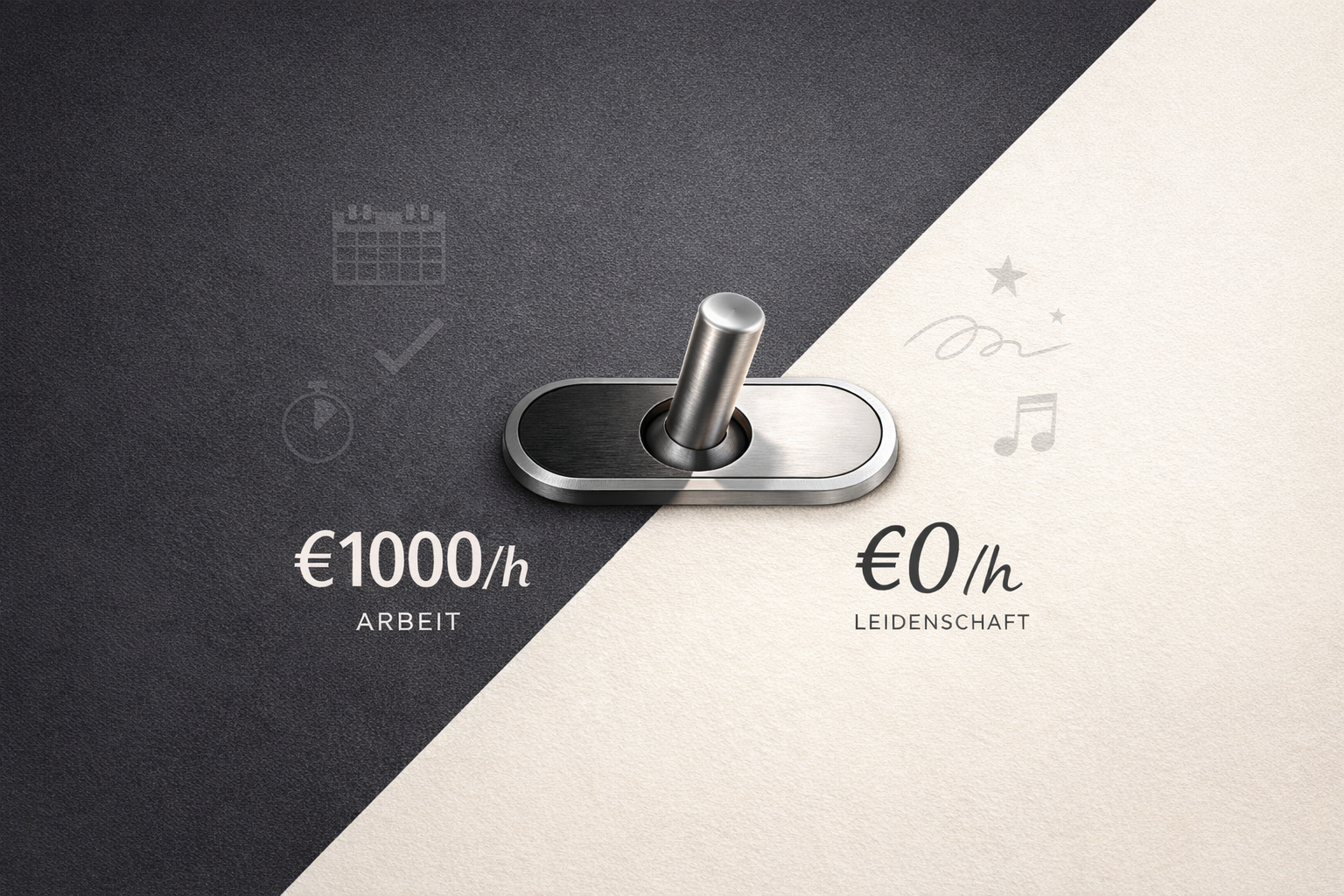
There is a scene I keep seeing in front of me: a switch. Metal. Heavy. Not the cheap plastic click thing you operate on the side, but a piece where the finger pauses briefly because it feels: This is a decision.
That is exactly how I treat time now as well. Not as “calendar filler”, not as a uniform mass, not as moral raw material that you can arbitrarily turn into obligations. But as two modes.
And yes: I express this in two prices. Provocative. Deliberately rough. So that it has an effect.
In short:
• I mentally price work at €1000/h. (Not because I charge that much. But because this number forces me to get serious.)
• I mentally price passion at €0/h. (Not because it is “worth nothing”. But because it must not be poisoned by ROI talk.)
• The result is not “more hustle” but less busywork – and more real impact.
If the numbers trigger you: good. The trigger is part of the system. We’ll get to that in a moment.
⸻
The method in one sentence
Treat working time like an extremely expensive good – and passion like a space in which you don’t have to prove anything.
That sounds banal. It is not.
Because most of us (mostly unconsciously) do the opposite:
• We give away work for €0/h: endless meetings, email ping-pong, small stuff, “can you just quickly”, decisions without decision.
• And we demand €1000/h from passion: “Is this worth it?”, “Does this bring anything?”, “Will this eventually become a product?”, “Is this efficient?”
This reversal is the hidden source of ineffectiveness – and of fatigue.
⸻
Why €1000/h works
€1000/h is not a business management number. It is a tolerability threshold.
Imagine you had to pay for every hour of “work” in cash – at the end of the day. Not with money, but with a very scarce account called attention, health, patience, relationship capacity.
At €1000/h you would suddenly do things you really should have done long ago:
1. You would define more clearly what “finished” means.
Not: “We’ll talk about it.”
But: “At the end there is a decision / a document / a commit / a go-no-go.”
2. You would see the price of context switching.
The problem is rarely the work itself. It is the constant switching.
(And yes: every “just quickly” is often a context switch in disguise.)
3. You would no longer politely play along with inefficiency.
Politeness is a virtue. But politeness is also an excellent cloak for waste.
€1000/h is the number that makes me insist on a question that is almost never asked:
“If this really costs €1000/h – what is the output here?”
And suddenly a lot of things become ridiculous. Not in the sense of “I am better”, but in the sense of: Why do we act as if this were normal?
⸻
Why €0/h is even more important
Now comes the part that many overlook: €0/h is not the “soft” side. It is the more dangerous – and the more sacred one.
Passion is the place where you:
• are allowed to think without an audience,
• are allowed to play without a result,
• are allowed to learn without justification,
• become yourself again without KPIs.
As soon as you tax passion with “return”, something poisonous happens:
• You start performing instead of exploring.
• You only choose what is likely to work.
• You lose exactly the quality that makes passion productive: innocence.
And now the irony:
If you treat passion as €0/h, it often later becomes the best €1000/h hours of your life – but as a by-product, not as a demand.
€0/h is the way you tell a system:
“Here something is allowed to emerge that I cannot name yet.”
That is not romantic. That is pragmatic. Because the world is not changed by those who only do what can already be billed.
⸻
Two modes, two truths
So that we don’t misunderstand each other:
Work (€1000/h) does not mean
• that you have to exploit yourself,
• that everything has to be monetized,
• that you have to be a “high performer”.
It only means:
If it is work, it must not be done cheaply.
Passion (€0/h) does not mean
• that you let yourself drift,
• that you never set boundaries,
• that you have to do everything “for fun”.
It only means:
If it is passion, it must not be poisoned by justification.
And yes – there are things that are both. Then the trick is: split. Not mystify.
“Doing a podcast” is rarely “both”.
Collecting ideas can be €0/h.
Answering sponsor emails is €1000/h.
Production can lie somewhere in between – and that is precisely why it has to be cleanly separated.
⸻
The 5-step implementation
1) Brutally sort: work or passion
Take your to-dos (or better: your calendar from last week) and mark each item as:
• A = work (€1000/h)
• L = passion (€0/h)
No mixed category. If you hesitate, it is usually work that you are romantically disguising.
Mnemonic:
If you only do it because you “have to”, it is work.
If you do it even though you don’t have to, it is probably passion.
2) The €1000/h filter: cut, delegate, bundle, standardize
For everything that is A, the following applies:
If the result does not plausibly justify the value of this hour: out with it.
And “value” does not only mean money. It can also be:
• risk minimized,
• clarity created,
• decision made,
• relationship stabilized,
• real quality delivered.
Four questions that are almost always enough:
1. What would be the simplest version that gets the job done?
2. Who should actually be doing this – if not me?
3. Can I build this as a standard instead of rethinking it every time?
4. Can I bundle it instead of tearing it into 17 micro-moments?
If you do it honestly, your “work” is drastically reduced. Not because you are less responsible, but because you stop confusing responsibility with small stuff.
3) The €0/h track: passion gets a slot
Passion is not what is “left over”.
If it is left over, it usually does not remain.
So: time block in the calendar.
Not as a “reward”, but as infrastructure.
And yes, here too: clear framework.
• Start time.
• End time.
• One sentence goal: “Today I just want to play / just read / just build.”
The goal is not output. The goal is state.
4) Track two currencies: result and energy
Most people track only result (and wonder why they dry out) or only energy (and wonder why nothing gets finished).
I track both – but separately.
• Work: What did I decide / deliver / complete?
• Passion: How do I feel afterwards? (clearer? calmer? braver? more alive?)
If your passion regularly makes you feel worse, it is not passion but usually escape.
5) Weekly check: Where did I lie to myself?
10 minutes. Honest. Without drama.
• Where did I make €1000/h work cheap?
(e.g. unprepared meeting, half-finished decision, distribution list too large, “we’ll see”)
• Where did I sacrifice €0/h passion in order to be “good”?
(and numbed myself with five hours of scrolling)
This check is the real engine. Not the method.
The method is the switch. The check is the regular flipping.
⸻
Concrete examples (so it doesn’t remain theory)
Example 1: Meetings
€1000/h standard:
A meeting without a decision is a conversation. A conversation is okay. But then don’t call it a meeting.
Minimal rule:
• Agenda in 3 points.
• One decision that is made at the end.
• Owner.
• Deadline.
If that is missing: cancel or make it asynchronous.
Example 2: Emails and “quickly”
Emails are often work that pretends to be communication.
€1000/h question:
“What is the smallest answer that triggers the next step?”
Often that is:
• a clear proposal,
• two options,
• a request for go/no-go.
Not a novel. Not five side topics. Not a little world history of the reasons.
Example 3: Creative work
Many make the mistake of “optimizing” creativity – and then wonder why it dries up.
€0/h rule:
• Today the goal is: a sketch, not a publication.
• One paragraph, not a chapter.
• One experiment, not a product.
Sounds small. Is big. Because it keeps the door open.
Example 4: Sports / body / health
This is where the classic confusion happens:
• Sport becomes work (because “must”),
• and work becomes the excuse (“I don’t have time”).
If sport charges you: €0/h.
If sport feels like punishment: then it is work – and must be organized in a way worthy of €1000/h (short, effective, plannable, without self-hatred).
⸻
The three dangerous traps
1) The hustle trap
If you only take the €1000/h part, you become efficient – and empty.
You get output but lose contact with yourself.
Then “effectiveness” becomes tyranny.
The system needs €0/h as backlight. Otherwise it is just a nicely designed self-overload.
2) The “passion as avoidance” trap
€0/h is not a free pass for running away.
A simple test:
• After passion you feel larger.
• After avoidance you feel smaller (even if it was pleasant for a moment).
If you are honest, you know the difference.
3) The self-mythology trap
“I cost €1000/h” can become an ego slogan.
Then it’s over.
Because the number is not a status symbol. It is a reminder:
Your lifetime is not cheap. Period.
If you use the number to place yourself above others, you have lost the principle morally.
(And usually also practically, because then you are performing again instead of deciding.)
⸻
A 30-minute start that really works
If you take only one thing with you, then this little exercise:
1. Write down 20 tasks (or take the last 20 calendar blocks).
2. Mark 5 of them as €1000/h work.
3. For these 5: eliminate 2 immediately. Radically.
(If you think “can’t be done”: delegate/bundle/standardize – but don’t “leave as is”.)
4. Mark 3 things as €0/h passion.
5. Block these 3 in the calendar – for real. This week. Not “sometime”.
After that your system will not feel “perfect”.
But it will feel like a truth that has finally been spoken.
⸻
Conclusion: The switch is not a symbol. It is a practice.
The method is not “time management”.
It is a small ethics of attention.
It says:
• Work deserves seriousness.
• Passion deserves freedom.
• And both deserve clear boundaries.
If you do this for a few weeks, something strange happens:
You work fewer “hours-wise” – and achieve more.
And you do more passion – without a guilty conscience.
Not because you are suddenly more disciplined.
But because you have finally stopped treating time as if it were a free good.
And right there, at that point, the switch clicks.