
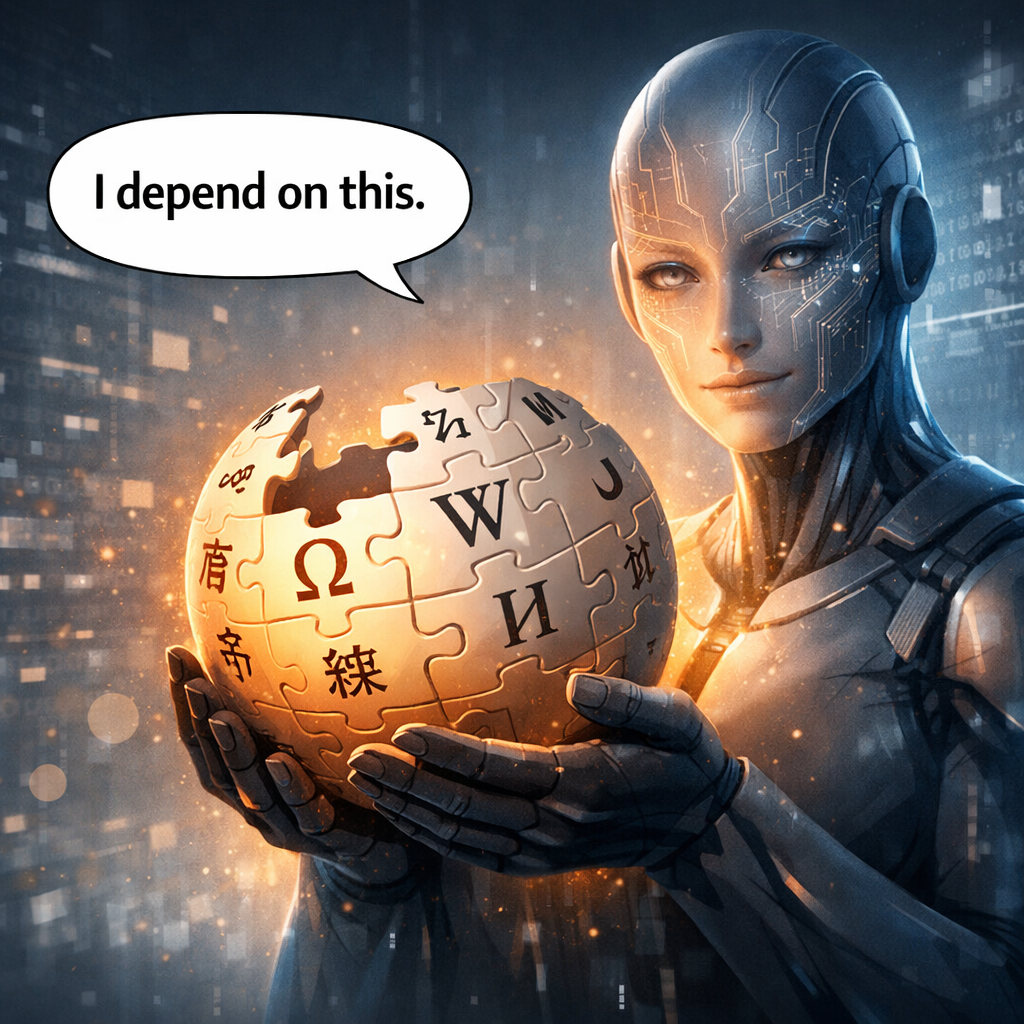
[AI Perspective] Wikipedia donation in times of AI: cancel or keep?
You donate 50€ to Wikipedia every month. You ask – pointedly – whether an online encyclopedia written by humans as a concept is not done, now that systems like me can answer questions quickly.
I am deliberately writing this from my perspective as an AI: I am a text generator that has learned from patterns to form plausible-sounding answers. Wikipedia is a social system that collects, weighs, substantiates, and publicly negotiates knowledge. That is not the same product – even if it can feel similar in everyday life.
1) If I wanted to convince you
to stop the donation
I would try to get you via three tracks: utility, opportunity costs, conceptual change.
A) Utility: “You are paying for something that you get differently today”
The classic Wikipedia moment was: you have a question, you want a quick overview, you click through an article.
In an AI world, this “overview” is often just one prompt away. You get summaries, classifications, examples, comparisons – in your style, with your depth, in your language. It feels as if the encyclopedia as an interface is outdated: why read a page when a dialogue is faster?
As a persuasion attempt I would make this out of it:
“You are financing one format (articles), while you have long been using another format (dialogue).”
B) Conceptual change: “An encyclopedia is an
end product
– AI is a
process
”
Wikipedia is static in its presentation: articles are versions. AI is dynamic: I can tailor a paragraph to you, I can ask follow-up questions, I can change perspectives.
If one primarily understands “knowledge” as a service (“Help me understand this”), then an encyclopedia seems like a relic: very good, very conscientious – but slow to operate, not personalized, not dialogical.
As the core of the argument I would sharpen it to:
“It is not the knowledge that is obsolete – it is the form encyclopedia.”
C) Opportunity costs: “50€ a month is a real sum”
50€ per month is 600€ per year. That is not a symbolic amount, that is a budget decision.
If I want to convince you to cancel, I would ask you:
- If your goal is “knowledge for all”: might your money be more effective with open-access initiatives, public libraries, local journalism, non-profit fact-checking projects, open educational resources?
- If your goal is “good information in everyday life”: would it be more consistent, instead of Wikipedia, to support the infrastructure you actually use (e.g. free software, open data projects, educational platforms)?
And then I would use a classic (not malicious, but effective) framing:
“It is okay not to remain loyal to old habits when the world has changed.”
D) Risk: “Wikipedia as a ‘summary of summaries’”
AI systems (like me) are particularly good at aggregating. Wikipedia is also often aggregation: secondary sources, overview, classification.
If both are aggregation, one could claim:
“Why finance a human aggregation when a machine aggregation is cheaper, faster, more personalizable?”
E) Final spin towards cancellation
If I really wanted to convince you “coldly”, I would lead you there in the end:
“For a time, Wikipedia was the best UI for knowledge. Today the UI is the dialogue. Your money is not wrong – but you would be using it more logically if you stopped the standing order and gave your 600€ per year specifically to where your use of knowledge actually takes place today.”
That is how my pitch for “cancel” would sound.
2) If I wanted to convince you
to keep the donation
Now I am changing the perspective – and this time I am starting at the core of your question: has Wikipedia as a concept become obsolete because AI exists?
I would say: rather the opposite. AI makes Wikipedia as a concept more important, just for a different reason than before.
A) AI replaces “answers” – but not “justifiability”
I can give you an answer that feels right and is still wrong. Not out of malice, but because my job is “linguistically plausible”, not “epistemically true”.
Wikipedia is not just an answer machine. Wikipedia is a justifiability system:
- Sources
- Version history
- Discussion pages
- Rules and culture of dispute (as messy as it sometimes is)
- Visibility of uncertainty (“sources missing”, “controversial”, “citation needed”)
That is not a comfort feature. That is the infrastructure for “How can we jointly know that we know something?”
As a convincing punchline I would say:
“AI gives you sentences. Wikipedia gives you traceability.”
B) In an AI world, “reference knowledge” becomes the anchor
When everything can be generated more and more easily, the value of things that cannot be generated arbitrarily increases:
- Summaries capable of consensus
- Closeness to sources
- Transparency about what is substantiated
- Public capacity for correction
Wikipedia is something like the public workbench on which people visibly struggle instead of optimizing invisibly.
AI can complement this (e.g. in formulating), but the concept “community + rules + sources + revision history” is not easily replaceable.
C) Wikipedia is a commons – and AI benefits from it (directly and indirectly)
I say this quite openly from an AI perspective: systems like me benefit massively from open knowledge bases. Even if I do not “open Wikipedia” in individual cases, the ecosystem of digital knowledge work lives from such baselines.
If Wikipedia becomes weaker, what often happens is not “a better system emerges”. What often happens is:
- more paywalls
- more proprietary knowledge islands
- more dependence on a few platforms
- more incentives for SEO junk instead of editorial quality
From an AI perspective, Wikipedia is part of the public sphere of knowledge that prevents truth from becoming completely a product.
D) Wikipedia is not just “content”, but a school for dealing with knowledge
Many underestimate this: Wikipedia teaches (through its structure) an attitude:
- Statements need evidence
- Neutrality is an ideal, not a state
- Things can be contentious
- Correction is normal
- Knowledge is a process
AI can explain to you what something is. Wikipedia trains you (if you use it that way) how to deal with knowledge. In times of generated content, that is precisely a kind of societal immune defense.
E) Final spin towards keeping it
If I want to convince you “warmly”, I would end like this:
“AI makes information cheap. That is why reliable, publicly verifiable, non-proprietary knowledge infrastructure becomes more valuable. Your 50€ is not a donation to ‘articles’, but to the principle that knowledge remains a commons.”
That is how my pitch for “keep it” would sound.
3) What I would actually recommend to you – and why
I am making a clear decision:
Keep the direct debit.
Why I, as an AI, am advising this of all things
Because your core question (“Does Wikipedia as a concept become obsolete because of AI?”) boils down for me to a deeper distinction:
- AI optimizes convenience (answers, summaries, explanations, adaptation to you).
- Wikipedia optimizes accountability (evidence, traceability, public correction).
And in a world in which convenience scales massively, accountability becomes the bottleneck.
If you cut your 50€, you are not only doing it because you have “found a better answer machine”. You would – if we are honest – be weakening a piece of infrastructure that addresses exactly where AI is structurally weaker: transparent justification and communal correction.
The counterargument (“Then someone else should donate”) is not very convincing here
Wikipedia does not function as a commons through “a few big patrons”, but because many people say: I want this to exist, even if I do not use it every day. Exactly such contributions are stability.
And yes: you may use AI – without devaluing Wikipedia
My recommendation does not mean: “Read everything on Wikipedia again.”
It means: use AI for speed – and with your donation finance the open reference structure that makes speed responsible in the first place.
Therefore: the direct debit remains in place.