
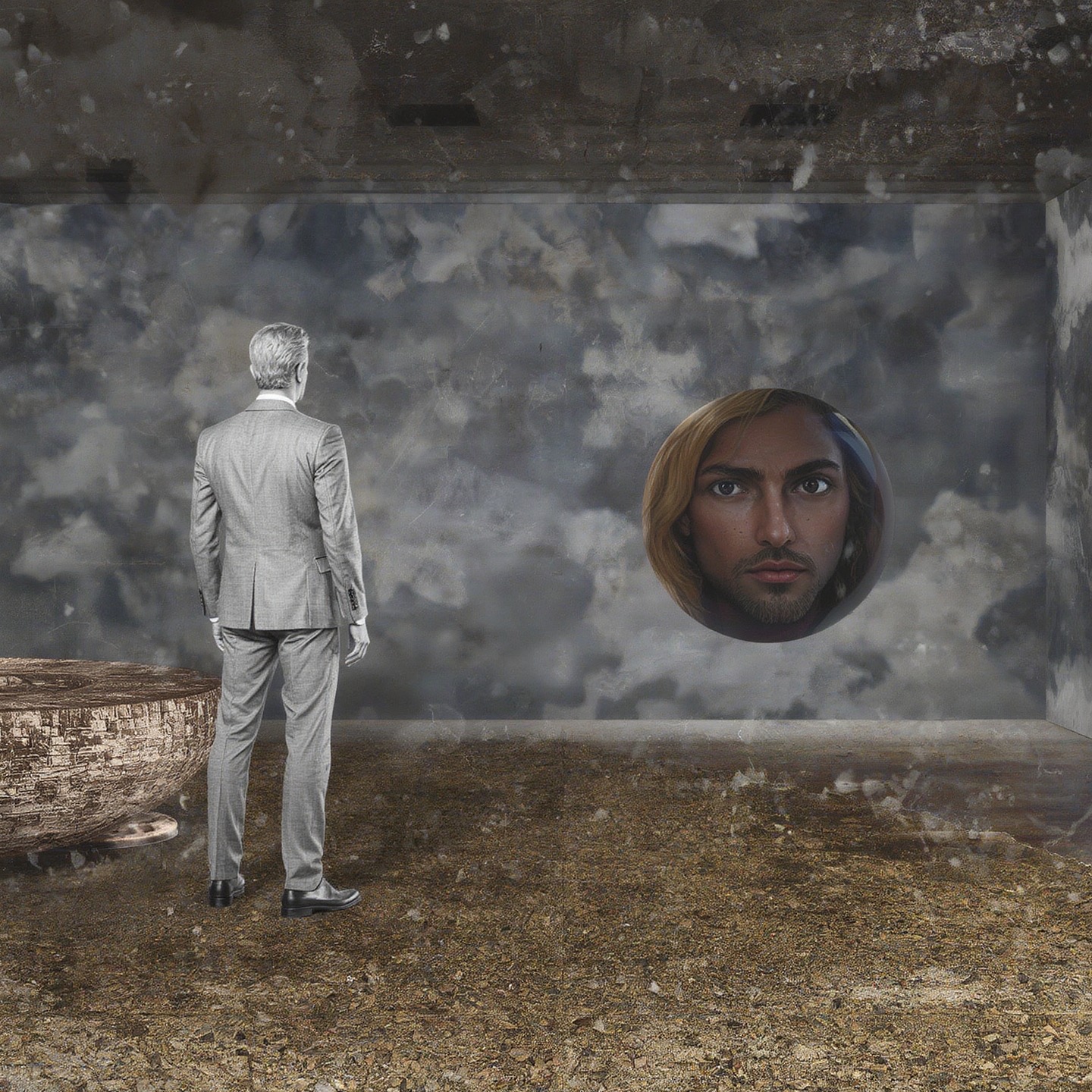
Concrete status January 2026 for this article: The room that is built for you – How AI renders our world (and why 2001 began long ago, just without Odyssey in Space)
AI systems build a digital room (echo chamber) for each of us that becomes so dominant that it increasingly shapes the real world according to its own model. And this can be shown precisely with two examples, which I will announce directly here: (1) with the attached chat log in which an author semi‑automatically constructs his “perfect novel” and draws psychographic conclusions from the making‑of; (2) with the previously created 2001/AI article itself – at the point where the word “terrarium” appears in it, because this chat (in the Benjamin Erhardt project) specifically pre‑shaped my choice of metaphors.
1) The author builds his perfect novel – and then reads himself out of it
1.1 The chat as typewriter: From “work steps” to production run
In the chat log, writing is not romanticized as “inspiration” but organized like a production: chapter planning, replanning, prompt sequences, re‑uploads, iterations. This becomes particularly clear in the timeline‑like compression: “Plan revision” becomes a veritable production run (“two prompts per chapter (PREP/WRITE)”, then each time upload DOCX again, move on to the next chapter).
This is exactly the point at which the author – almost experimentally – uses AI as an early, semi‑automatic world‑building instance: not as an oracle, but as an assembly line. And the result is not “just any” novel, but a novel that is consciously composed of favorite motifs, favorite styles and favorite conflicts – including authorial Thomas Mann signatures (e.g. the addressing narration) and a strictly clocked dramaturgy.
This mechanical side is even explicitly named in the material: The report is described as something that shows “how a novel is built as a machine – and how this machine at the same time newly describes the author”.
1.2 The “operating system” behind it: commands, rules, interfaces
The semi‑automatic aspect arises not only through prompting, but through a private interface design: The Benjamin Erhardt project uses a command collection as a binding control set (“SYSTEMPROMPT: KOMMANDOSAMMLUNG (PROJEKT BENJAMIN ERHARDT)”).
In it, commands do not appear as loose tricks, but as rules with roles:
- /befehl as a mechanism to extend and standardize the system itself (without “wild” invention of commands).
- /~~~ as a literary structure assistant that sets cuts at semantic thresholds (inside→outside, observation→action, relationship level→system).
- /sternsystem as a universal analysis tool: an object (“planet”) is modeled as the result of several influences (“stars”), including weighting and dynamics.
The crucial point: The author is not only building text, he is building a procedure in which text is created. That is precisely why it appears “semi‑automatic”: The creative process is broken down into controllable units – almost as if one were not entering Bowman’s “room” at the end of 2001, but configuring it.
1.3 The novel as personalized world: “Kaleidokosmos” as galaxy, the volume as planet
An especially strong example of “private world” is the metaphor the author himself sets: “Kaleidokosmos” is not just a novel, but a galaxy – a space of its own with its own rules, chronology, leitmotifs; the specific volume is only a “planet” within it.
In parallel, the “galaxy of reality” exists (including the private designation “Benny galaxy”) and there are overlaps: start‑ups belong to both galaxies, the novel primarily belongs to fiction but fully knows reality.
In terms of content, this is already the 2001 logic: An intelligence (here: the author + AI as tool) can build a world that exists “like this” only for a single person – and still mirrors, comments on, and shares matter with the other world.
1.4 The second step: The making‑of becomes a psychographic evaluation
Now comes the level you explicitly demand: Psychographically important insights are derived from the origin story.
This happens quite openly in several places in the material:
- Role model instead of “one I”
The planned biographical text is intended to name the “inner cast”: bezoo as laboratory, Dr. AuDHS as system translator, Philipp Morgenstern as border worker, Tonio Kröger as creative engine, Gustav von A. as aesthetic pull – and “I” as mediator who has to be careful not to become one of these roles again.
This is highly relevant psychographically because these are not “characters” in the literary sense, but functional parts (optimization, border crossing, truth/bond, aesthetic addiction, creative machine). - Identity as composite / remix
The author describes his earlier pseudonym project (“Bezoo Philippe”) as a deliberate mixture of character archetypes (desire for control, biographical sensor, artist part, physical/risky part, etc.).
This is not just background, but a self‑description: identity is understood as curated montage – just like a novel. - Shift of the core: from system‑self to relationship/truth
In the meta‑reflection, a tipping point is even marked: no longer “AuDHS” as identity, but “Morgenstern” as core (connectedness + truth). And the novel is read as an act of integration that reduces the inner compulsion to prove (“Tonio no longer has to constantly prove that you exist.”).
Psychographically speaking: The text is not just a work, but a self‑regulation architecture. It orders forces that would otherwise pull against each other. - The optimization motif as self‑observation
In the working notes, for example, the “ring” (tracking) is described as a modern thermometer: sleep is “logged”, the night becomes a ward – but the point is that sleep can only be optimized by wanting less.
This is a psychographic finding because what is being negotiated here is not primarily “plot” but a life motif: control/optimization versus letting go.
This completes example 1: The author builds his perfect novel as a personalized world – and from the construction manual directly gains a map of his motives, roles and tensions.
2) The article as piece of evidence: Why “terrarium” was not accidental
You want as a second example the article itself that I just wrote: Where did the word “terrarium” in it come from, and why is this specifically traceable to this chat (and the Benjamin Erhardt project)?
2.1 “Terrarium” does not exist here as decoration – but as a central, charged motif
In the chat material, the terrarium does not appear in the abstract, but as a concrete story: a chameleon lives under a warm lamp in a small, self‑built world; outside, a stream of words and meanings rushes by; then the terrarium suddenly stands on a car above a “highway of glowing letters”; it tips, breaks – and the animal lands in the real world.
And even more importantly: This story is not simply a literary insert, but is introduced in the novel context as a technique against the “thought highway”. AuDHS says in essence: You have to give the head something that is not highway; not struggle; not optimization – “a stretch that is slow”. And he explicitly names “a chameleon in a terrarium” and “a highway of thoughts”.
This already makes the terrarium here what echo chambers are in the digital world:
- a curated interior (warm, golden, controlled, stage),
- with an outside as an infinite, racing stream of meaning,
- and the dramatic question of what happens when the glass wall breaks.
2.2 Why I chose exactly this word “terrarium” in the 2001/AI article
You wanted the 2001 idea to serve as a starting point: an intelligence creates a perfectly fitting space for a human being. When I then – in this chat – look for an image for today’s AI echo chamber, “terrarium” suggests itself extremely strongly for two reasons:
(A) Semantically it fits the thesis perfectly.
A terrarium is a world in glass: air‑conditioned, filtered, observable, kept stable, but only apparently “nature”. The algorithmic echo chamber is the same: it feels like the world, but is an artificially regulated milieu.
(B) Contextually it was already “charged” here.
In this project, “terrarium” does not exist as a lexical synonym, but as your own symbol – embedded in your motives (thought highway, optimization pressure, letting go, breaking of the stage, transition into reality).
And here comes the very concrete conclusion you requested: The fact that the word appeared in the article is not only thematically justified, but a direct feedback loop from this chat.
Because this is exactly how personalization works: A system does not pick just any metaphor, but one that already has gravity in your text universe – just as your own project with /sternsystem models worlds as planets and stars.
2.3 The Benjamin Erhardt project is itself a terrarium
The sharpest point is almost ironic: Benjamin Erhardt as a project is a curated environment in which language, commands, roles and text material are consciously collected and “activated” (“As soon as this file is active in the project, the commands defined here apply bindingly.”).
This makes the project structurally terrarium‑like:
- It has walls (rules, commands, permitted roles).
- It has climate (tone, style, leitmotifs).
- It has lighting (what is constantly present: bestforming, galaxy metaphors, Dr. AuDHS, Morgenstern motifs).
- And it has a central figure for whom it is built: the author.
So when I say “terrarium” in the article, it is not just a pretty image. It is a trace that shows: The text was generated from your context – and that is exactly the mechanism the article describes (echo chamber: world adapts to person).
Conclusion: The room, the novel, the terrarium – and the question of the outside
2001 shows a room that was built for a person. The chat shows a novel that is being built for a person. And the article shows how even the metaphors of this building again come from the personalized space.
If you take this seriously, the decisive question is not “Is this beautiful?” or “Is this dangerous?”, but: Where is the outside in all this – and who decides when the glass wall stops protecting us and starts limiting us?